Writing an OSR Module on One Page
The spirit of Old School Renaissance is, at its core, a return to simplicity, creativity, and the ability to improvise. It’s a philosophy that prioritizes substance over form, tools over scripts. No exercise encapsulates this mindset better than the challenge of creating a complete, playable adventure module on a single page. This isn’t merely a design trick or an artificial constraint; it’s a rigorous discipline that forces the creator to distill the adventure down to its purest, most functional elements. Writing a one-page module is a focused masterclass, teaching us that what’s left out is just as important as what’s included. The end result isn’t a sketch, but a masterpiece of efficiency, an elegant set of tools that empowers the Game Master to run a dynamic and memorable session with nothing more than a sheet of paper and an understanding of the game’s fundamental principles.
The power of a one-page module lies in its immediacy. It eliminates the barrier of excessive preparation, allowing a Game Master, even with limited time, to have an adventure ready to run. In a world where modern modules can extend to hundreds of pages of intricate lore and complex plots, the one-page approach serves as a revitalizing antidote. It recognizes that the true magic of RPGs lies not in the designer’s prescribed words, but in the live interaction at the table, in the players’ decisions, and in the Game Master’s interpretations. This format places the responsibility for the narrative where it belongs: in the hands of the people who are playing. The module is not a novel to be followed to the letter, but a robust skeleton upon which the meat of the campaign will be built in the heat of the moment.
The Philosophy of the Essential: Less is More
Before putting pen to paper, it’s crucial to internalize the design philosophy underpinning this endeavor. The guiding principle is tabletop utility. Every word, every line, every element of the module should serve a direct functional purpose during the game. If information isn’t likely to be needed by the Game Master during a typical session, it should be mercilessly cut. This means eliminating lengthy paragraphs of backstory, irrelevant NPC biographies, and flowery descriptions of environments. Instead, the focus should be on what players can interact with, what they can find, and what they can do. The module is a toolkit, not a tourist guide.
This approach demands radical trust in the Game Master. The designer doesn’t need to foresee every eventuality or provide all the answers. The goal is to provide the building blocks—locations, characters, threats, and treasures—and trust that the Game Master will use them to build the adventure in real time, adapting to the unpredictable actions of the players. This trust is liberating. It allows the module to be incredibly dense in playable content without being overwhelming. Visual aesthetics are also an integral part of this philosophy. A clear layout, with a well-defined information hierarchy and the strategic use of white space, is as important as the text itself. The page should be easy and quick to read, allowing the Game Master to find the information they need with a simple glance.
The Four Pillars: Location, Threat, Treasure, and Secrets
Every OSR module, regardless of its size, rests on four fundamental pillars: the Location, the Threat, the Treasure, and the Secrets. In a one-page module, these pillars are not mere sections; they are the central organizational structure. The Location is the stage, the physical environment where the adventure unfolds. The Threat is the conflict, the active force opposing the players. The Treasure is the reward, the material incentive for the risk. And the Secrets are the depth, the layers of mystery and meaning that transform a simple foray into a memorable story. The art of compressing an adventure onto a page is the art of distilling each of these pillars into their most potent form.
The location should be immediately understandable and easy to navigate. For a one-page module, this almost always means a single, self-contained location: a small dungeon, an abandoned tower, a monster lair, or a desecrated sanctuary. The map is the centerpiece. It should be simple, clear, and designed to be read at a glance. A point-of-interest style, where each room or area is represented by a simple, numbered symbol, is ideal. Avoid winding, complex corridors; opt for a logical layout with a limited number of areas—five to twelve is a perfect range. Each number on the map corresponds to a concise entry in the text. The description of each location should be one or two sentences at most, focusing on three things: what is immediately visible, a potential hazard or interactive feature, and a clue or point of interest that might lead to something else. For example, instead of writing a paragraph about the history of a chapel, write: “1. Chapel in Ruins. A demonic idol has replaced the altar. Dried blood stains the floor. A sacred symbol is hidden behind a loose brick (Save vs. Poison to remove without being stung by a scorpion).” This gives the Game Master everything they need to describe the room and react to the players’ actions.
The Threat is the heart of the conflict. In such a compact module, the threat must be focused and thematic. It could be a single powerful creature with its minions, a small but cohesive faction, or an environmental curse. The key is that the threat has an active presence on the site. It doesn’t passively wait in the final room; it patrols, hunts, performs rituals, or expands its territory. Include a short random encounter table—perhaps only four entries—that reflects this threat. For the boss or main threat, provide an ultra-compact statistic. In OSR-based systems, this could be as simple as: “The Corruptor, A Pale Shape (AC 14, MV 12, HD 6, AT 1 claws (1d8 + level drain), ML 9). Level Drain: Victim makes a Save vs. Death or loses 1 level/round. Weakness: Direct sunlight causes 1d6 damage/round.” This small text box contains all the necessary information for a climactic fight, including a unique mechanic and an exploitable weakness, without taking up unnecessary space.
Treasure is the fuel that powers progression in OSR. In a one-page module, treasure should be more than just gold coins; it should be interesting, thematic, and sometimes problematic. Instead of listing long loot tables, place specific treasures in specific locations on the map. A treasure should tell a story. The cultist’s chest doesn’t just contain gems; it contains “50 gp, a cat’s eye necklace (100 gp) that seems to follow whoever looks at it, and a blood-signed infernal contract that compels the bearer to commit murder.” This not only provides wealth but also creates new adventure hooks. Magic items, if included, should be strange and have unusual drawbacks or functionalities. A one-page module is the perfect place to introduce a sword that speaks to the dead but requires blood sacrifices, or a shield that can block magic but is afraid of the dark. These items generate much more gameplay than a simple numerical bonus.
Ultimately, secrets are what elevate the adventure from a simple monster slaying spree to a truly memorable experience. A secret is a piece of information that changes the players’ perception of the location or threat. Perhaps the cult leader isn’t a villain, but a desperate man trying to save his daughter from a curse. Perhaps the dungeon isn’t a building, but the petrified body of a minor god. Perhaps the treasure isn’t gold, but a dragon egg about to hatch. Secrets should be scattered throughout the location, in the form of diaries, murals on walls, or in the conversations of subdued NPCs. They provide the depth that makes players think and engage with the world beyond combat. In a one-page module, two or three interconnected secrets are enough to create a web of intrigue.
Step by Step: Building the Adventure
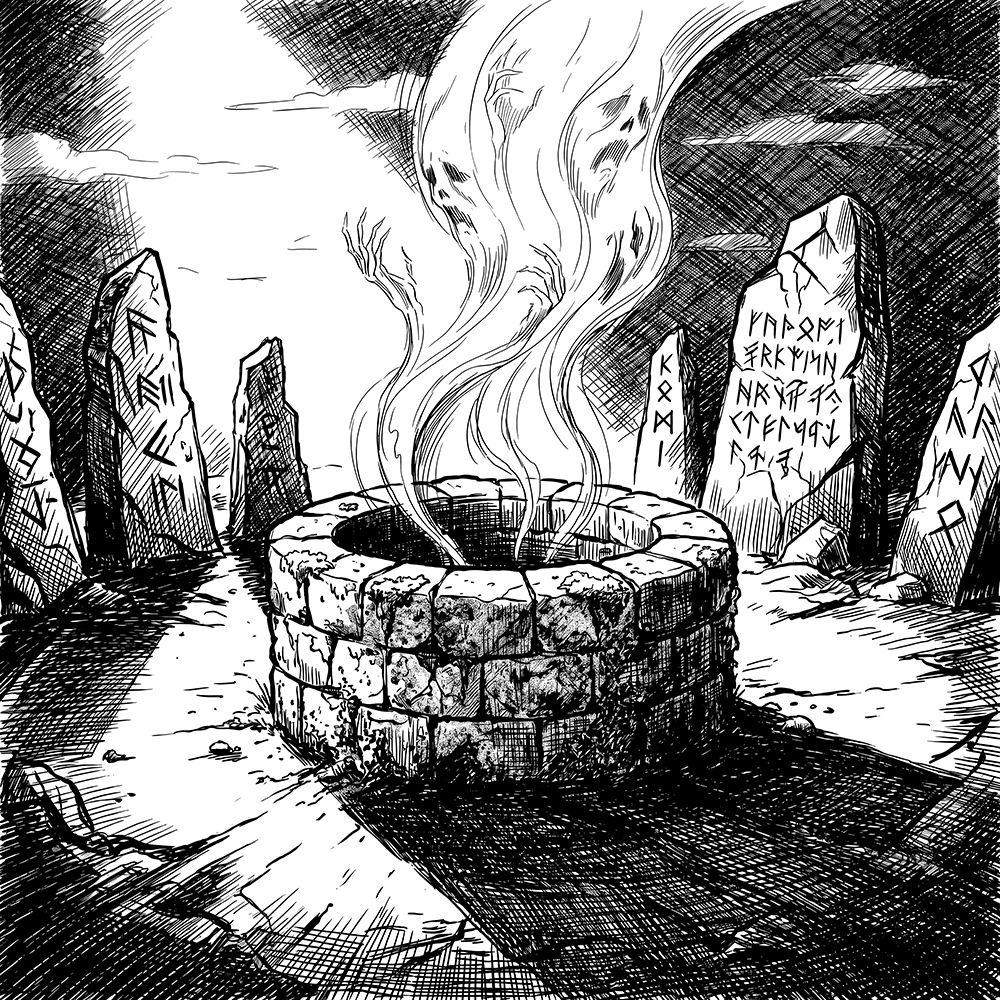
Let’s now apply these principles to a step-by-step creation process. Imagine we are creating a module called “The Well of Whispering Bones”.
Step 1: The Central Concept. Begin with a single, high-concept sentence. Example: “A sacred well, corrupted by a bony shaman, now curses the land around it. The bones of the dead whisper secrets of betrayal.” This immediately gives us the Location (the well), the Threat (the bony shaman), a potential Treasure (whatever lies at the bottom of the well), and a Secret (the betrayal).
Step 2: The Map. Draw a simple map. The Well is the central point. Around it, we have: 1. Entrance to the Stone Circle; 2. Followers’ Camp; 3. Bone Altar; 4. The Whispering Well; 5. Underground Chamber (accessible only through the well). The map is circular and simple, with perhaps five areas. This is more than enough.
Step 3: Populate the Locations. Now, write an entry for each number on the map.
- Entrance to the Circle of Stones: Leaning runic stones. Runes warn: “Here lies truth, and truth corrupts.” Any undead entering the circle must make a Will save or be paralyzed by fear.
- Followers’ Camp: Three starving cultists (HD 1) are cooking a rat. They know that the Bone Shaman (Urgok) betrayed their tribe’s chief to obtain the power of the well. They are afraid and can be bribed with food.
- Altar of Bones: Human and animal bones arranged in a circular pattern. A skull in the center whispers the same word repeatedly: “Treachery…”. If destroyed, it releases a Vengeful Spirit (HD 3) that attacks the nearest being.
- The Whispering Well: A deep, dry well. Whispers rise from it, revealing the darkest thoughts of those who hear them. Descending requires a rope and a Climbing check. The bottom leads to area 5.
- Underground Chamber: Urgok, the Bony Shaman (AC 15, HD 4, AT 1 Bone Staff (1d6) or Necrotic Ray (2d6, Save vs. Death for half damage)), is performing a ritual over a black water source. The treasure—an amber amulet (500 gp) that binds the soul of the true boss—is beside him. If Urgok is killed, the whispers cease.
Step 4: Define the Threat. We have already defined Urgok. Now, we create a small encounter table for the outdoors (areas 1-3): 1. A wandering skeleton (HD 1); 2. The three cultists on patrol; 3. A swarm of necrophagous insects (1d4 damage/round); 4. A ghostly vision of Urgok’s treachery.
Step 5: Sowing the Treasures and Secrets. The main treasure is the amber amulet. But the true secret lies in the whispers and the story of betrayal. A cultist’s diary in the camp (area 2) may contain the truth: the true leader, Grumbar, did not die in battle, but was poisoned by Urgok, and his soul is trapped in the amulet. If the amulet is destroyed, Grumbar’s soul is freed, blessing the players and healing the land. This gives the players a moral choice and a way to resolve the adventure without necessarily killing Urgok—perhaps they could negotiate with him or free Grumbar to confront him.
Step 6: Review and Layout. Now, bring all these pieces together on a single page. Use a large, clear title. Place the map in a corner, clean and legible. List the numbered areas in a column. Include monster statistics in compact boxes. Use bold for keywords like Urgok or Amber Amulet for quick reference. The final text should be concise and direct, taking up less than a page when drafted, so it can be neatly formatted and styled attractively.
Execution at the Table
The beauty of such a compact module is its flexibility. A Game Master can pick up “The Well of Whispering Bones” and run it in a three-hour session without any prior preparation. During the game, the Game Master isn’t reading long blocks of text; they’re using the concise notes as a springboard for their own description. Secrets are revealed organically. If the players ignore the cultists, the secret of betrayal might be discovered through the whispers in the well or the skull on the altar. The Game Master is free to improvise, knowing that the core structure is solid but not rigid.
This format is also perfect for sandbox campaigns. A one-page module is a point of interest easily inserted into a larger map. “The Well of Whispering Bones” could be just one of many locations players hear about in the local village. Its short length means the Game Master can have a dozen of these modules ready, allowing the campaign to unfold in a truly player-driven way.
In conclusion, the art of writing a one-page OSR module is much more than an exercise in minimalism. It’s an affirmation of the core values of OSR: creativity over storytelling, tools over scripts, and the Game Master’s agency over the designer’s authority. It forces us to identify and refine what is truly essential to an RPG adventure—an interesting location, a credible threat, a tempting reward, and a mystery worth unraveling. By mastering this form, designers and Game Masters not only create incredibly accessible and usable content, but also rediscover the pure, unadulterated core of what makes a role-playing game work. On a single page, we can capture a world of possibilities.