Objective vs. Subjective Rules
The trajectory of Dungeons & Dragons (D&D) is a fascinating journey that reflects a fundamental shift in the design philosophy of tabletop RPGs: the transition from a Dungeon Master-centered model to a System-centered model. This evolution, especially evident when contrasting the early editions (D&D Core, AD&D 1st Edition) with the modern ones (from the 3rd Edition onwards, culminating in the 5th Edition), lies in the difference between subjective and objective rules.
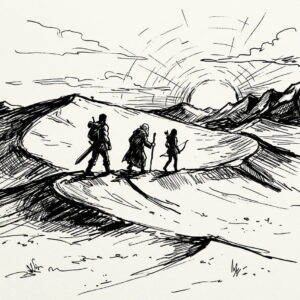
In the “Old School” editions of D&D, the prevailing design philosophy can be summarized in the maxim: “Rulings, not Rules.” The rulebooks were not intended to be an exhaustive legal code capable of covering all possible character interactions with the world. On the contrary, they provided a sparse and intentionally incomplete toolbox. The main focus was on essential mechanics, such as combat and dungeon exploration, and the rules themselves were often ambiguous, leaving large gaps. This subjectivity was a characteristic, not a flaw.
The power and responsibility to fill these gaps rested entirely in the hands of the Game Master. When a player attempted an unusual action, such as using a curtain to slide down a wall or negotiating with an ogre, the Game Master didn’t consult an appendix of “Rules for Using Curtains in Free Falls.” Instead, they used the closest rule (a Dexterity check, perhaps), applied an intuitive modifier based on common sense, and arbitrated the outcome. The rule was merely a starting point; the Game Master’s judgment was the resolution to the conflict. This encouraged improvisation and ensured that narrative and world logic took precedence over mechanical rigidity.
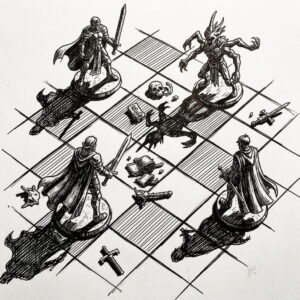
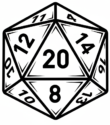
Starting with the Third Edition (3E) in 2000, and continuing into the Fourth (4E), the philosophy changed drastically. The influence of video games, as discussed in the previous text, demanded an objective and coherent system. The d20 System unified almost all actions under a single d20+Modifier≥ Difficulty mechanic, transforming subjective arbitration into a precise mathematical calculation. From then on, the goal of rule design became to address all possible interactions. In this modern model, the objective rule clearly delimits the scope of the character’s action. For each situation (climbing, intimidating, disarming traps) there is a specific die roll, with defined modifiers and a pre-established or calculable Difficulty Class (DC). The system becomes a design grid, ensuring that, regardless of the Game Master, the mechanical result for an action is the same. The player, in turn, tends to interact with the world using the actions that the system offers (“Actions, not Judgments”), focusing on optimizing the character sheet to maximize these results.
The transition to more objective and comprehensive rule systems in modern editions of Dungeons & Dragons has created a paradoxical burden for the game’s central figure: the Dungeon Master (DM). While the DM previously acted primarily as a judge, whose main task was to exercise intuitive arbitration to ensure the coherence and enjoyment of the story, more recent editions have transformed them into a kind of logic-applying machine and a real-time data processor. This overload has the direct cost of undermining the DM’s participation in the creative and improvisational construction of the narrative. The problem lies in the vastness and interconnectedness of modern rules, especially in the 3.x (including 3.5) and 4E editions. In these systems, most character actions depend on the precise sum of long chains of modifiers: Feats bonuses, condition penalties, situational bonuses, and complex interactions between spells and abilities. The DM, instead of focusing on describing the environment or interpreting a monster’s reaction, is forced to maintain an exhaustive mental accounting log. He needs to track the status of dozens of creatures and characters, correctly applying each +1, -2, or +4 bonus, ensuring that the Difficulty Rating (DC) or Armor Class (AC) calculation is mathematically accurate at all times.
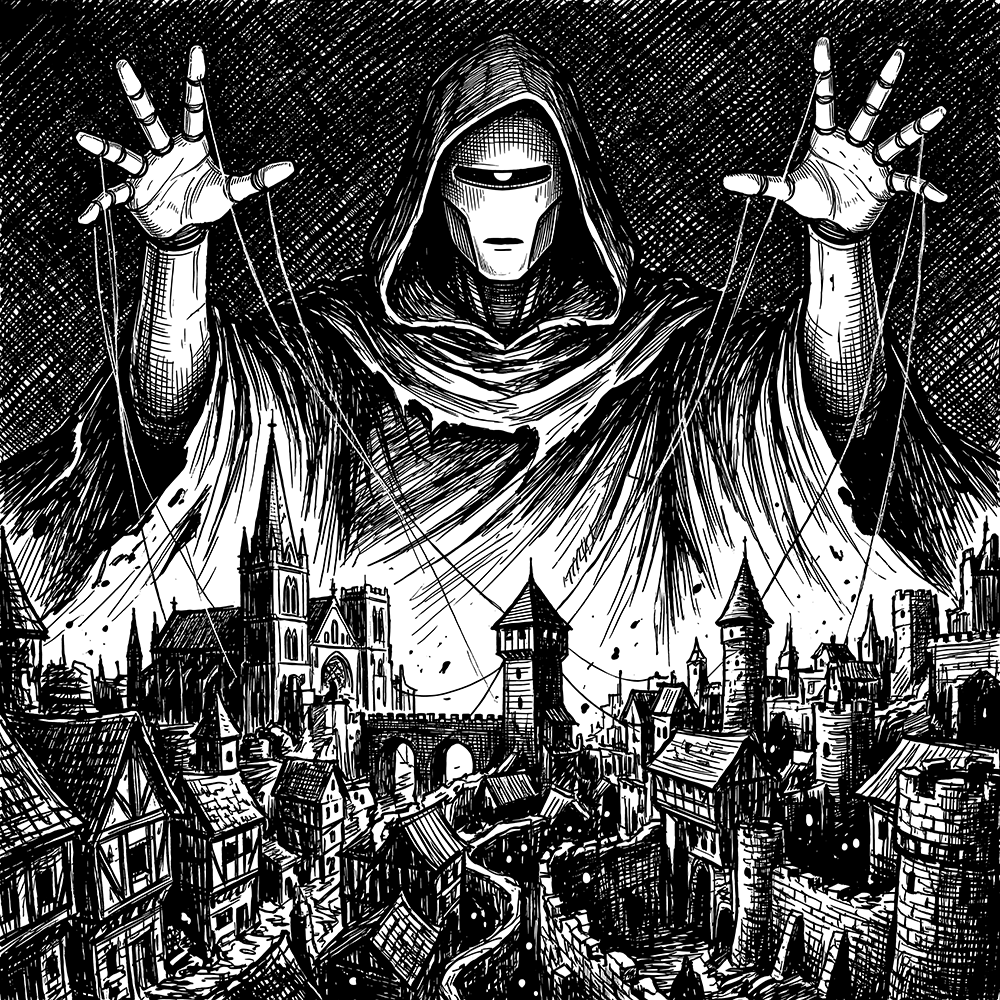
This task of mechanical management becomes so burdensome that it diverts the Game Master’s mental energy from the creative sphere to the administrative sphere. When a player tries something outside the rulebook, the Game Master no longer thinks about “What would be fun/logical here?”, but rather “Is there a rule for this? If not, what is the closest rule? What modifiers apply?”. The narrative rhythm breaks down, and the moment of creative improvisation is replaced by a lengthy consultation of a reference book or a mathematical discussion at the table. In essence, the system transforms the Game Master from a co-narrator and actor (responsible for bringing the world to life) into a human game engine, whose main function is to ensure that the rules software is running without bugs or calculation errors. The result is that creative construction, which was the essence of arbitration in older editions, is sacrificed for the pursuit of absolute mechanical justice. The 5th Edition attempted to mitigate this with the introduction of the Advantage/Disadvantage system, which simplifies most modifiers to a simple double dice roll. However, the general trend of objective rules persists: they tend to predefine most outcomes, limiting the space for the Game Master’s and players’ imaginations to freely collaborate. When the system already has a codified answer for everything, the need for improvisation diminishes, and the gaming experience risks becoming a predictable series of tactical encounters, where the beauty of the story gives way to the perfection of calculation.
This transformation of the Game Master, from intuitive arbiter to rules processor, has had a profound social consequence on the hobby: a shortage of Game Masters. In older editions, being the Game Master was a prestigious and highly desirable role, as creative authority over the world and freedom of arbitration were the main attractions. There was often healthy competition to see who would take the position. However, the weight of the cognitive overload imposed by the detailed rules of the 3x and 4E editions has driven away many potential Game Masters, who did not wish to dedicate themselves to memorizing lengthy manuals and performing complex calculations in real time. This shortage has generated a recent and growing phenomenon: the Professional Game Master. This is an individual who is paid by groups of players to plan, prepare, and narrate game sessions. This market, which values the dedication and time of those willing to assume the heavy mechanical and creative responsibility of the modern DM, is the ultimate testament to the fact that the role, once a coveted pleasure, has become a specialized service and, often, too expensive to be pursued as a mere hobby.
Capitalism and the Expansion of Hobbies
The evolution of Dungeons & Dragons rules from subjective to objective is inseparable from a greater force: the need for profit and the influence of capitalism on the hobby. Gary Gygax’s original vision for RPGs was deeply rooted in the “do it yourself” (DIY) ethic. The early books provided the foundations, the fundamental rules of combat and exploration, but intentionally left vast blank spaces. The expectation was that the Dungeon Master, equipped with these tools, would create their own world, their cities, and their adventure settings, customizing the experience for their group. The product was the engine, but the landscape and the plot were the player’s responsibility.
However, TSR (Tactical Studies Rules), the original publisher, quickly realized that the true financial potential lay not only in selling the initial game engine, but in supplements and pre-made content. Business logic dictated that the continuous sale of books, adventure modules, monster guides, and campaign settings (such as Forgotten Realms) was infinitely more profitable than the one-time sale of a core rulebook. The hobby shifted from an exercise in collaborative creativity and self-sufficiency to a content consumption model. The message changed from: “Here are the rules; now, create your story!” to: “We have every type of adventure you’re looking for, every monster you want, and every detailed setting you need.”
This shift in focus, from creation to consumption, had drastic consequences for the entry-level hobby and, especially, for the role of the Game Master. If, initially, a Game Master needed a basic toolbox and imagination, the new model demanded the acquisition of a triad of expensive books: the Player’s Handbook, the Dungeon Master’s Guide, and the Monster Manual. Beyond the financial cost, there was an intellectual and temporal cost: the modern Game Master was obliged to know well not only the essential rules, but also the myriad of specific rules contained in modules and supplements, requiring an unprecedented level of preparation.
One of the most rewarding aspects of being the narrator in older editions, the creation of a completely original campaign setting, was subtly taken away from the Dungeon Master. With the proliferation of official worlds rich in lore and history, the Dungeon Master was encouraged to buy and follow these settings instead of creating their own. The Dungeon Master thus became a tour guide for these pre-made worlds, and creative energy was diverted from world-building to world-building and rules management. Ultimately, the capitalist drive to expand the catalog and monetize content transformed D&D, making it more accessible in terms of material (everything is ready-made), but drastically more demanding in terms of investment (time, money, and effort), redefining the Dungeon Master’s role from a DIY artist to an administrator of a vast and complex commercial product.