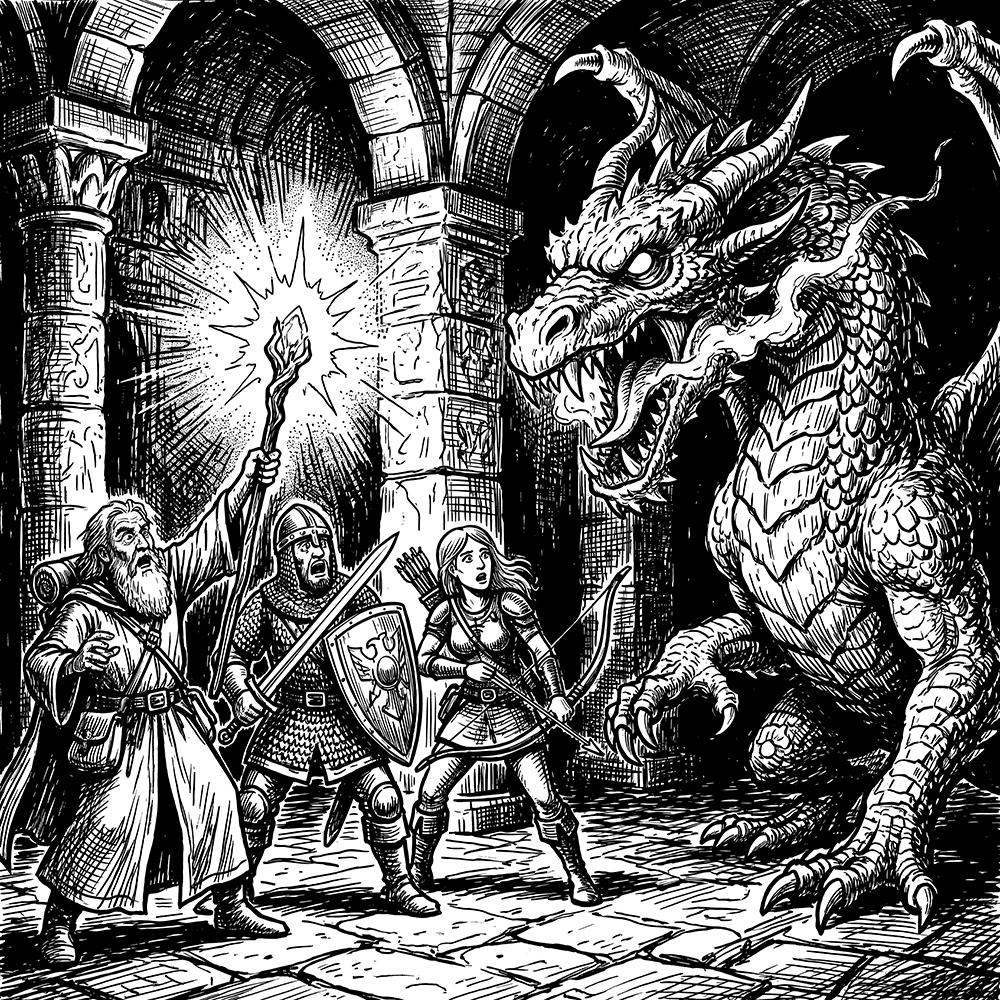
Unbalanced but Fair Encounters
There is something profoundly wrong with the way many RPG players approach combat these days. Sit at the table, describe an imposing creature emerging from the entrance of a cave, and watch. Almost invariably, the players’ hands reach for the dice. Swords are drawn. Damage spells are prepared. There is a silent expectation, an unwritten contract between the game master and the players: if it’s there, it’s because we can kill it.
This expectation didn’t arise out of nowhere. It’s the result of decades of evolution in RPG design, a journey that began in the early days of the hobby and has brought us to the current paradigm of “balancing.” To understand how to present unbalanced but fair encounters—the backbone of the OSR (Old School Renaissance) style—we first need to understand how we got here.
The Age of Common Sense
In the late 1970s and early 1980s, when the original D&D and AD&D 1st edition reigned supreme, the concept of “balancing” as we know it today simply didn’t exist. TSR’s adventure modules featured dungeons with levels that varied drastically in difficulty. At level 1, you might face some skeletons. At level 2, well, maybe a minotaur. At level 3, a vampire. If you went down to level 4 too early, your character would die. Simple as that.
The structure was simpler, yes, but not for lack of sophistication—it was a matter of philosophy. Gygax and Arneson weren’t designing a “balanced game.” They were designing a world . And worlds don’t care about the level of their characters. A cave that has housed a dragon for three hundred years isn’t suddenly going to change its inhabitants just because a group of level 3 adventurers decided to explore it.
In that era, the game master had a fundamental responsibility: to communicate the danger. The clues were there. The peasant in the nearby village spoke of the mountain’s “breath of death.” Charred bones adorned the cave entrance. The module’s very name— The Mad Mage’s Dungeon —already suggested that things beyond the characters’ comprehension inhabited those corridors. The game master arbitrated, the players decided, and the consequences were merciless but predictable.
The Birth of the Challenge Level
Everything changed with the arrival of D&D 3rd edition in 2000. Wizards of the Coast, then recently acquired by Hasbro, had a clear mission: to professionalize and systematize the game. Part of this effort came in the form of the Challenge Rating (CR) system, a brilliant tool in theory, problematic in practice.
The idea was noble. The design team, led by Monte Cook, Jonathan Tweet, and Skip Williams, wanted to give game masters a reliable tool for gauging a creature’s potential difficulty. A monster with a CR of 5 would, in theory, represent an appropriate challenge for a group of level 5 characters. The game master could then build encounters with the confidence that they were neither underestimating nor overestimating their players.
For a time, it served as a support. Novice game masters had a crutch, an anchor to begin understanding the power dynamics in the game. But something insidious began to happen over the years with the arrival of 3.5, then the 4th edition (which took balancing to almost pathological levels of surgical precision), and finally the 5th edition.
The level of challenge has gone from being a supporting factor to becoming a rule .
The Rambo Generation
The change was cultural before it was mechanical. At some point along the way, players began to expect that every combat presented by the game master would be winnable through direct confrontation. More than that: they began to consider any deviation from this expectation unfair .
I know the scene by heart. The group finds an ancient dragon sleeping atop its treasure. Instead of retreating, planning, negotiating, or even considering alternatives, the players advance. Combat begins. The dragon uses its breath weapon. Half the group dies in the first round. The surviving player turns to the game master and, with legitimate indignation, asks: “Why did you set up an unbalanced combat?”
Do you see the inversion? The assumption embedded in the question is that every conflict presented is a battle designed to be won . This player isn’t role-playing an adventurer in a dangerous world. They’re playing a video game where enemies scale with their level, where difficulty areas are clearly marked, where the mere fact that an encounter exists means it’s been calibrated for the player’s progress.
I call this generation “Rambo” for a reason. Rambo, after all, faces entire armies alone and wins. Not because the world is realistic, but because the genre demands it. These are players who have learned—through osmosis, through years of exposure to balanced systems, through campaigns where the game master never dared to present anything that couldn’t be resolved through brute force—that combat is the standard and always viable solution.
If you’re an OSR game master migrating from more modern systems or receiving players accustomed to this philosophy, be prepared: there will be a clash of expectations. Your players will blindly rush towards danger. They will believe that if you described an opponent, they were calculated so that the team has a chance to win through brawling. They will feel betrayed when this doesn’t happen.
Your challenge, as a game master, will be twofold: first, to teach them a new way to play. Second, to ensure that their unbalanced encounters are, nevertheless, fair .
And that’s where foreshadowing comes in.
Foreshadowing
“How can a challenge be fair if it might even be insurmountable?” That’s the central question, and the answer lies in a narrative technique as old as the art of storytelling itself: foreshadowing .
Foreshadowing is the art of planting subtle or direct clues that anticipate future events in the narrative. In film, it’s that seemingly irrelevant shot of a dagger over the fireplace, which will reappear in the climax of the third act. In literature, it’s the loose phrase about the “cruel fate” that awaits the hero. In OSR RPGs, it’s the difference between a group that dies burned by the dragon and a group that, armed with information, chooses a different approach—or decides that that cave, today, is not worth the risk.
The game master already knows there’s an ancient red dragon in the cave. He knows the group of four level 5 characters doesn’t stand a chance in a direct confrontation. The question that determines whether the encounter will be fair or unfair is simple: did they receive clues that it was there?
Let’s work with a practical and detailed example.
The Case of the Red Dragon
Situation: The group responds to a desperate call from the village of Carvão Queimado, a small community of miners and goat herders nestled at the foot of the Serra dos Ventos mountain range. The message sent by a messenger is succinct and alarming: “The destroyer has come. Village in ruins. We need warriors. Bring help. Bring everything.”
When the characters arrive, they find exactly what the message suggested: Burnt Coal no longer exists. Where there were once stone huts and thatched roofs, now there are smoking craters and molten glass. The smell of burnt flesh. Sepulchral silence, except for the crackling of some still-burning wood.
A small group of survivors is camped at a safe distance, next to the herd of goats that miraculously escaped. It is led by Hargrave, a middle-aged woman with a face marked by soot and tears. She recounts what she saw—not much, really. The attack happened at dusk, while most of the adults were in the fields in the hills to the south. Those who remained in the village died. The elderly, children, the sick who couldn’t work. Dead. Charred. Extinguished.
“I was in the field,” Hargrave says, his voice trembling. “I saw it… that thing coming down from the sky. It was big. Red as embers. And the heat… the heat arrived before it did. Trees caught fire two hundred paces away just from its approach. When it opened its mouth, the whole sky turned to fire.”
She points east, toward the mountain range. “The thing went that way. We have the trail—carcasses of forest animals, all burned, and blood. Lots of blood. It killed while fleeing, for pleasure. You can follow the smell of burning and the buzzing of flies.”
And then Hargrave drops the crucial piece of information, almost as an aside: “The Marquis sent help. A week ago, before the attack, when we were still just scared, not knowing what was killing our cattle. He sent twenty soldiers. Shining plate armor, horses, broadswords. Elite troops, he said. The best men in the east. They went up the mountain to hunt the beast.”
Pause. She swallows hard.
“They never came back.”
Twenty elite soldiers. Full armor. A week-long search. No return. No bodies. No sign of battle except for a few footprints that fade uphill.
This is the first sign. The game master didn’t say, “You’ll die if you go into combat.” The game master showed it. Twenty trained soldiers, with equipment superior to anything the characters could have at level 5, went and didn’t return. If the group is even slightly sensible—and this is the central point of OSR—they will stop. Think. Plan. Investigate. They won’t simply march up the mountain with their swords drawn.
But confident groups, optimistic groups, groups trained in video games, go. “Ah, we are heroes,” they say. “We have magic. We are protagonists.” And they ignore the warning.
The Second Warning: The Entrance to the Lair
Let’s suppose that the group, despite the warning, decides to pursue the beast. The game master won’t stop them—OSR isn’t about the game master “protecting” the players from themselves. It’s about arbitrating consequences. The group follows the trail of destruction and climbs the mountain.
After several hours of walking through an increasingly silent forest (where are the birds? Where are the squirrels? Why hasn’t any animal been seen in the last few kilometers?), they arrive at the entrance to a gorge that leads to a colossal cave. The entrance is twenty meters high. The surrounding stone walls are blackened, smooth, almost vitrified by intense heat.
And then they see the bones.
These aren’t the bones of ordinary animals—deer or bears or wolves. Large skeletons. Very large. An ogre skull, still with its rusty helmet stuck in one of its horns. Troll vertebrae, recognizable by their unusual thickness. Ribs that belong to something the size of a hill giant. All the bones are charred, fractured, as if they had been chewed and then spat out.
Whatever is living in this cave has made ogres and trolls its regular food. It’s picking its teeth with the bones of creatures that, individually, would already be a daunting challenge for the group. That’s the second red flag.
Still, the players can choose to enter. The game master describes the interior of the cave: the suffocating heat that intensifies with each step, the walls that glow with a faint blush, as if the stone itself were incandescent. The smell of sulfur and molten metal. The sound of something large breathing—a slow, rhythmic breath that makes the ground tremble slightly.
And then, in the dim light at the back of the cave, a form. Red scales reflecting the light of the distant magma. A wing that extends. Part of a tail that moves sleepily.
Red dragon.
The players can attack now. They can try their luck. And if they do, they will probably die. Not because of the master’s malice, not because of “injustice,” but by their own choice. They received warnings. Multiple warnings. They ignored them all.
But — and here’s the beauty of well-applied foreshadowing — they can also do something different.
The Alternative Solution: The Real Challenge
If the players decide that a direct approach is suicidal (and rightly so), they can retreat and investigate further. What brought the dragon here? Red dragons don’t usually leave their mountains without a powerful reason. Something is wrong.
With a bit of exploration of the surrounding area (and perhaps some successful Survival or Investigation rolls for the more systematic), the characters notice something strange. The mountain to the north—the highest in the range—is covered in snow. Fresh snow. In the middle of summer. In a region where, in no living memory, has there ever been snow.
If they investigate this anomaly, they will find an abandoned tower on the icy peak. The tower belonged to a powerful wizard named Valdris, who died approximately a year ago in a laboratory accident—or so the rumors say. Inside the still-functioning tower, the characters discover a complex magical artifact: a crystal sphere pulsating with icy energy, surrounded by damaged control runes.
Examining the wizard’s records (a half-burned diary left on a workbench), the characters learn the truth. Valdris hated dragons. His original tower was on a nearby mountain, but a red dragon—the same one from the cave—dwelt in the magma caverns deep within, and Valdris lived in fear of an attack. He spent years developing an artifact capable of altering the local climate, creating an eternal blizzard that would force any warm-blooded creature to abandon the region.
It worked. The dragon left. But the device was never deactivated, and with Valdris dead, the snow continues to fall—now threatening to bury not only the mountain, but the entire valley below.
Meanwhile, the dragon found a new home: the cave in Burnt Coal.
The characters now have a choice. Facing the dragon is almost certainly death. But they can return to the tower, study the artifact, and figure out how to deactivate it. Perhaps they need to break the containment runes. Perhaps they need to carefully remove the crystal sphere (Dexterity roll or an appropriate spell). Perhaps they need a specific magical object that is… well, elsewhere in the tower, guarded by ice golems that Valdris left behind.
When the snow stops and normal weather returns, the dragon—a territorial creature par excellence—returns to its old lair in the snowy mountains. The threat to Burnt Coal is over. The characters earn the gratitude of the survivors, perhaps even a reward. They solved the problem. They won. Without ever having exchanged a single blow with the dragon.
This is an unbalanced, but fair, encounter. Unbalanced because, in direct combat, the group doesn’t stand a chance. Fair because all the clues were there from the beginning, waiting to be read by anyone willing to pay attention.
Game Master’s Tools: How to Build Your Own Fair and Unbalanced Encounters
The story of the red dragon is a model. But how can you, as a game master, apply these principles in your own sessions? Here are the practical tools of the trade.
The Three-Land Rule
In any situation where there is an unbalanced danger, offer at least three clues of increasing difficulty before the characters reach the point of no return.
- A distant clue: Rumors in the village, tavern stories, survivor accounts. “Twenty soldiers never returned.”
- A clue nearby: Physical evidence along the way. Bones of powerful creatures. Signs of destruction. Traces of struggle that show the disparity in power.
- Immediate clue: Something at the very entrance of the danger. The unbearable heat. The sound of breathing. The partial vision of the threat in its surroundings.
If the players ignore all three, the consequence is entirely theirs.
Escape as a Valid Option
Teach your players that fleeing is always an option. And more: that fleeing well is a skill as important as attacking well.
Have clear rules for escape in your system. In classic D&D, fleeing an encounter usually requires the characters to reach a passage or door that the monster cannot pass through. In modern OSR, many systems have rules for “escape checks” where players risk one last attack or one last defense before retreating.
And, crucially, don’t penalize escape . Game masters who have monsters relentlessly pursue characters through three rooms, or who impose narrative punishments (“you escape, but you lose the experience and the village is destroyed”) are teaching the wrong lesson. Escape should be a moral victory. Living to fight another day is often the best option.
Breaking the Video Game Paradigm
The most difficult obstacle you will face as an OSR game master isn’t mechanical—it’s cultural. Your players have been trained for years, decades perhaps, to think of RPGs as a cooperative video game with dice. And in video games, with very rare exceptions, every enemy that appears on the screen can be defeated. Areas have “recommended levels.” Bosses have attack patterns that can be learned. If you die, the game gives you a checkpoint.
RPGs are not video games.
One of the fundamental principles of OSR is that the world doesn’t care about you. It doesn’t scale. It doesn’t adapt. It simply is . Dangers are scattered throughout the world in varying degrees of difficulty, often completely beyond the characters’ capabilities. It’s up to the players —not the characters, the players —to know how to choose their battles, retreat when necessary, plan when possible, and negotiate when intelligent.
The game master, in turn, has only one job: to arbitrate the consequences of the players’ choices in a consistent and fair manner.
This means:
- Don’t hide the seriousness of the danger. Offer clues. Lots of clues. Redundant clues. Clues that scream out at you.
- Don’t save the players from themselves. If they ignore all the clues and move forward, let the consequences come.
- Don’t punish caution. If they retreat, investigate, plan, reward them with information, opportunities, victories that don’t require combat.
- Don’t predefine solutions. The wizard with the ice artifact is one solution. Your players can think of others—use diplomacy with the dragon, find an even better location for it to move to, trick it into falling into a ravine. If it’s creative and plausible, let it work.
Rescuing the Soul of RPGs
The OSR movement didn’t emerge by chance. It is, in large part, a reaction to what mainstream RPGs have become: a game of invincible heroes facing perfectly calibrated challenges, where death is rare and combat is the answer to almost everything. Many players who started in this environment never experienced the genuine tension of a dungeon where the next corner might bring something that simply cannot be overcome . They never felt the joy of solving a problem without drawing a sword. They never learned that sometimes the best victory is the one that happens without a single attack roll.
This needs to change.
As game masters, we have a responsibility to rescue that lost soul of RPGs. Not because “things were better in the old days”—nostalgia is a terrible advisor. But because the OSR style offers something the balancing paradigm has lost: real agency, real consequences, choices that matter. When players know they might face something deadly, every decision takes on weight. Every corner is a question. Every combat is a risk assessment, not a die roll.
The technique of foreshadowing is your most powerful tool in this mission. It allows you to populate your world with dragons, liches, minor gods, and cosmic horrors—all completely unbalanced for the characters’ current level—without it feeling unfair. The clues are there. The alternatives are there. If the players choose the path of death, let it be by their own choice, not out of ignorance.
The next time you prepare a session, ask yourself: Is there something here that my players can’t win directly? If so, how will I let them know? What clues will I plant? What alternatives exist? What happens if they ignore everything and advance anyway?
Answer these questions honestly, apply foreshadowing generously, and then release your players into the world. They might surprise you. They might do something brilliant that you didn’t foresee. They might also die trying a stupid approach.
And that’s okay. Because in OSR, unlike video games, the story isn’t about winning. It’s about the choices you make along the way — and living (or not) with the consequences.