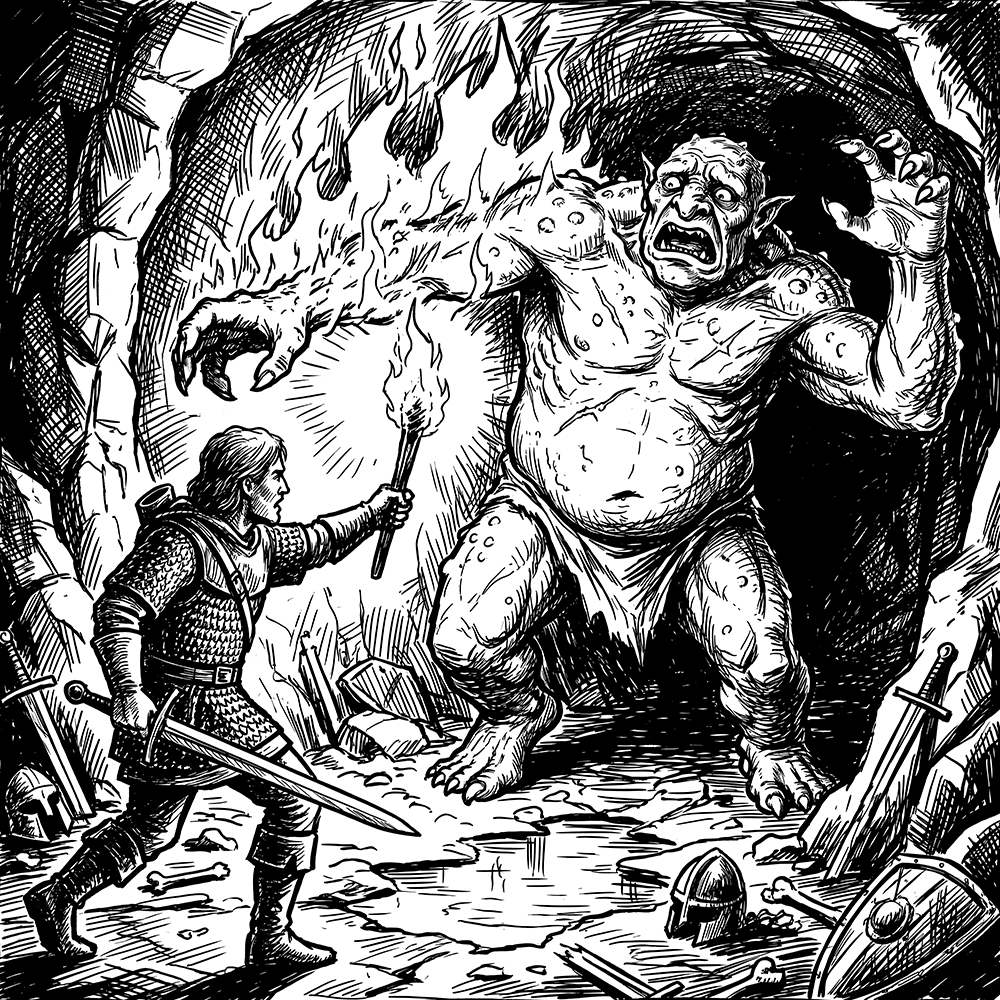
The Monster Is Not a Bag of Life Points
At the heart of the Old School Renaissance, OSR, beats a philosophy simple in its conception, but profoundly transformative in its application: the game is, above all, an exercise in consequences, in player-led ingenuity, and the existence of a world that follows its own rules, indifferent to the presence or power of the characters. It is a game ecosystem where internal logic and verisimilitude are the master pillars. In this distinctive setting, monsters cannot be reduced to mere obstacles placed on a predetermined path, destined to be overcome through optimized and calculated violence. They are the very embodiment of the unknown, the silent guardians of forbidden and forgotten treasures, the tangible manifestations of the danger that haunts a fantastic and, above all, relentless world. An ogre, therefore, will never be just a stat block that says “OGRE: AC 15, HP 59, +6 to hit, 2d8+4 damage”. An ogre is, in essence, insatiable hunger, a stench that precedes its arrival, a stupidity with brutal and unpredictable consequences. It is the trail of broken trees and crushed bushes leading to its fetid lair, the pulverized bones scattered around its primitive campfire, and its primal and simple desire for fresh meat, be it human, horse, or another weaker ogre that crosses its path. To reduce such an entity to a mere sum of hit points is to empty the world of its meaning and transform the adventure into a spreadsheet.
This article aims to completely dismantle the reductionist “HP bag” approach and provide the Game Master with a set of practical tools and a robust mental framework for creating monsters that constitute complex and narrative encounters , not merely tactical combats . We aspire to create monsters that players will remember not for the massive damage they caused or the amount of resources they drained, but for the unique and intriguing problem they represented, and the creative, desperate, or brilliant solution they were forced to devise to overcome it, or simply to survive its presence. A memorable monster is one that generates a story around the table, an anecdote that will be told long after the character sheet has been filed away.
To fully understand the need to go beyond the statistical sheet, we first need to dissect the anatomy of an encounter in the OSR style and clearly understand why the traditional monster model, prevalent in many modern RPGs, is antithetical to the experience that OSR seeks to cultivate. The first and most critical point of divergence lies in the almost obsessive focus on balance . The idea, now almost axiomatic in many systems, that each encounter must be “balanced” or “calibrated” to the average level of the group removes, by itself, any sense of real danger and organic world. Players, even unconsciously, internalize an implicit safety: if the monster appeared, it’s because they should be able to defeat it in a fair fight. The Dungeon Master, or the rulebook, wouldn’t put them in a truly impossible situation. In OSR, the world doesn’t care about your level. An encounter with an Adult Red Dragon for a group of first-level characters is not an epic challenge to be overcome with heroism and sharp rolls; It’s an invitation to a quick death and an ultimate test of player-led wisdom. Escape, stealth, negotiation, or deception are not only valid options, they are often the only wise ones. The world exists independently of heroes, and its threats don’t scale to provide a comfortable gaming experience.
The second point of contention is the centrality of combat as the default solution. When a monster is conceived as a set of numbers focused almost exclusively on armed conflict – its damage, its resistance, its hit points – the range of possible interactions narrows dangerously. The standard response to any encounter becomes, almost by conditioned reflex, “roll initiative.” This reductionism exhausts the players’ tactical repertoire, transforming a game of exploration, discovery, and ingenuity into a series of mechanical and predictable exchanges of blows. Finally, there is the inherent lack of verisimilitude in the “HP bag.” A creature that is merely a numerical abstraction is an empty entity. It doesn’t eat, it doesn’t sleep, it doesn’t fear, it doesn’t reproduce, it has no motivations. It simply exists in a state of limbo, awaiting the moment to be killed by the adventurers. This approach brutally breaks the immersion in a world that should feel alive, coherent, and full of cause and effect. A living world is one where all creatures, from the most insignificant to the most terrifying, have internal purposes and ecologies .
A successful OSR encounter is, at its core, the presentation of a problem for the players to solve: “There’s something scary, dangerous, and unknown in that dark room. What do we do?” The solution to this problem may, in fact, be combat, but with equal probability and validity, it could be negotiation, stealth, elaborate deception, intelligent use of the environment, or a desperate, strategic retreat. The monster, therefore, must be designed from its conception to facilitate and even encourage these multiple approaches. It must be more than an opponent; it must be an ecological and behavioral puzzle.
To effectively transcend the stat sheet and build creatures that truly fit this philosophy, we need to erect our monsters upon four fundamental and interconnected pillars: Behavior and Ecology, Attacks and Special Abilities, Weaknesses and Vulnerabilities, and finally, Treasure and Reward. The first and most crucial of these pillars is, without a doubt, Behavior and Ecology. This is the soul of the beast, the dimension that transforms a jumble of numbers into a living, breathing entity. Before even considering Class Armor or Hit Points, the Game Master must sit down and answer a set of basic, yet profound, questions. What does this creature eat? Diet defines primary motivation. An aggressive carnivore will actively hunt, a territorial herbivore will fiercely defend its territory, a magic devourer will seek enchanted items, a dream eater might attack campers in their sleep. Where does it live? A monster is a direct product of its environment. A creature from the depths of a cave might be blind, dependent on echolocation, and have a pathological aversion to or vulnerability to bright light. A swamp monster would likely be amphibious, able to camouflage itself in mud and water, and might use lures like willow lights to attract unsuspecting prey.
How does it socialize? Is it a solitary creature, a burrow hunter? Does it live in coordinated packs? Does it possess a complex society with distinct castes, like ants or bees? Packs imply ambush tactics, calls for reinforcements, and a group morale. Solitary creatures may be more territorial, predictable in their habits, but also potentially more deadly to compensate for their lack of numbers. What is its main objective beyond mere survival? To protect its territory, accumulate treasure like a dragon, reproduce and expand its colony, worship an obscure god through specific rituals? A clear objective directly informs how the monster will react to intruders. Will it see them as food, as a threat to its home, as a potential offering, or as insignificant intruders? And finally, how does it hunt or fight? Is it an ambush predator, attacking from the dark? A relentless pursuer, exhausting its prey? Does it use poison, paralyze its victims for later consumption, or slowly and terrifyingly drain their vitality or even their life essence? Answering these questions is not an academic exercise; it is the foundation upon which all interaction will be built.
To illustrate this pillar, let’s take a practical example: the Pale Butcher. Its diet is carrion, but with a twist: it prefers magical or recently enchanted carrion. It is irresistibly drawn to active magical items and the remains of magical creatures. Its habitat is the depths of ancient dungeons, necropolises, and places where potent magic has been dissipated in cataclysms. Socially, it is solitary, but it can tolerate the presence of others of its kind near a particularly abundant source of magical carrion. Its goal is simple: to find and consume arcane remains. Its combat behavior, therefore, is not aggressive by nature. Instead of attacking immediately, it first “assesses” the presence and magical potency in the group. If a character is carrying a visible magical item, the Pale Butcher will focus on trying to steal it and flee, attacking only if directly threatened or if, after its assessment, it detects no magic, then seeing the group as “common food” and not as a source of premium arcane nutrients. This simple ecological exercise transforms a potentially deadly combat into a scenario of theft, resource defense, and tactical decision-making.
The second pillar, Attacks and Special Abilities, defines the active danger the monster represents. In OSR, an attack shouldn’t be a mere line of damage. It should be a tactical threat that forces players to immediately rethink their standard approach. It’s necessary to think about effects that fundamentally alter the game state, not just reduce a resource bar. Level or experience point drain is a terrifying classic deeply rooted in OSR. A vampire or specter that drains levels is infinitely more fearsome than one that simply deals physical damage. The loss is permanent, or at least very difficult to reverse, and affects the character’s effectiveness in the long term, representing a corruption of their very soul and their heroic journey. Another formidable ability is paralysis or petrification. It removes a character from the fight immediately, creating an intense dramatic urgency: “We need to finish this thing off quickly or rescue our petrified companion before it’s too late!” Medusa is the archetypal and definitive example of this type of threat.
Mind control is another devastating tool, as it turns the tables on the group. A controlled companion becomes a dangerous opponent and a profound moral dilemma. Will the players hesitate to attack their friend? Will they simply try to immobilize them? How will they deal with the consequences of their actions after the control is broken? Abilities involving theft or deterioration of items cause instant tactical panic. A “rust monster” that consumes metal armor and weapons is a logistical nightmare for warriors and a stark lesson in not being exclusively dependent on equipment. A spectral thief stealing precious items, scrolls, or even bags of coins forces the group to rethink how they carry their treasures. Area and field control effects, such as a web-spit that traps characters in an area, poisonous gases that fill an entire corridor, or attacks that cause magical darkness, force the group to move, use the environment to their advantage, and break static battle formations. The ability to call for reinforcements transforms a simple encounter into a logistical nightmare. A simple goblin becomes a much greater threat if it lets out a high-pitched whistle that will bring in 2d6 more goblins over two rounds. This teaches players, in a practical and unforgettable way, the value of silence, quick elimination, and battlefield control.
It’s vital to remember that a special ability doesn’t have to be an active attack. It can be a passive and equally lethal defense. The classic Gray Ooze doesn’t possess spectacular magical attacks or elemental breaths. Its defining characteristic is the ability to dissolve metal . The mere attempt to hit it with a sword or axe can result in the instant and irreparable destruction of the weapon. This simple ability is as memorable, tactical, and terrifying to a warrior as any energy beam, because it attacks not the character, but their identity and resources.
The third pillar, Weaknesses and Vulnerabilities, is what transforms a merely dangerous monster into a puzzle to be solved. If a creature is only a source of damage and resistance, it is an obstacle. If it has a clear, yet not immediately obvious weakness, it becomes a problem that demands a solution . The players’ ingenuity is rewarded in a more tangible and satisfying way when they manage to discover, investigate, and exploit this weakness. Classic elemental weaknesses are effective precisely because they are legendary and provide players with a clear and achievable goal that goes beyond merely dealing damage. Werewolves and silver weapons, trolls and fire or acid, vampires and stakes through the heart, sunlight and holy water – these are narratives embedded in the mechanics.
However, weaknesses can and should be far more creative than simple elemental damage. Sensory or behavioral weaknesses open up a vast array of possibilities. A blind monster that hunts exclusively by sound can be tricked by distant noises created by the players, allowing for a stealthy passage. A being of pure logic and reason, such as a construct or an extraplanar entity, can be confused and paralyzed by a logical paradox presented by a cunning player. A greedy being, such as a dragon or a demon, can be bribed with a treasure greater or more interesting than the one it guards or even the adventurers’ own lives. A nocturnal and photosensitive predator may have a physical aversion to sunlight or holy light, recoiling and becoming disoriented under its influence.
We can go even further, creating specific and unusual weaknesses that become the core of a small adventure. A Flesh Golem can be controlled by the magical pergma embedded in its skull, which can be ripped out by an agile rogue in a very risky attack. A Ghost can only be dispelled and find peace if its earthly object of attachment – a ring, a diary, an earring – is destroyed, properly buried, or taken to a specific location. A creature made of pure chaotic magic can be destabilized by an antimagic field or a successful Dispel Magic Spell, causing it massive damage or even annihilating it. The key to a good weakness is that it is not immediately apparent. It must be discovered through research in old tomes in a city library, through careful observation of the monster in its habitat (players may notice that it consciously avoids a certain type of bioluminescent fungus in the dungeon), or through courageous and costly experimentation (“Fire didn’t work, it laughed! Let’s try acid! What if we throw holy water?”).
The fourth and final pillar, Treasure and Reward, connects the monster directly to the OSR game economy, where XP is often gained through treasure recovery, not monster defeat. The treasure guarded by a monster must therefore make sense within its established ecology. Kobolds, being small, cowardly, and fascinated by shiny things, will have piles of small objects of questionable value: bone buttons, polished stones, tin rings, rusty copper coins, and pieces of colored glass. A dragon, vain and greedy, will have an organized pile and sleep on gold, gems, and artifacts of incalculable value. Our Pale Butcher, a devourer of magic, might have a collection of broken, unloaded, or randomly used magical items that still possess valuable internal components for an alchemist.
But the treasure goes far beyond coins and gems. The creature itself can be a mine of resources. Players can collect valuable body parts, a concept known as “greater salvaging.” They can carefully extract venom from the giant viper, enough to coat 1d4 arrowheads or dagger tips. They can collect the specialized glands of a creature with fire breath to try and create a fire resistance potion. The hide of an invisible creature can be treated by a specialized tanner to try and craft a cloak with camouflage properties. Horns, teeth, and especially sturdy or ornate bones can be sold for a good price to collectors or used as rare components for crafting powerful spells. This practice not only enriches the game materially but also encourages players to see monsters as part of a resource ecosystem, not just as sources of XP.
And perhaps the richest reward of all is the gift of a monster that remains alive. The greatest reward may not even be killing the creature. Players can, through clever roleplaying, risky negotiation, or the performance of a service, manage to negotiate safe passage with a wise and solitary Elder Dragon. The “treasure” here is life itself, access to forbidden territory, a powerful (and volatile) ally for future crises, and above all, an incredible story of diplomacy and sagacity in the face of overwhelming power.
To solidify this entire theory, let’s get our hands dirty and create a monster from scratch, meticulously following the four pillars. Our central concept will be a creature that feeds not on flesh or bones, but on time and memories. We will call this creature the Chiral Parasite. Regarding its Behavior and Ecology, its appearance is ethereal and translucent, without a defined or constant form, resembling a ghostly jellyfish. Its surface reflects light like oil on water, and from it emanates a low, constant, and cacophonous whisper, sounding like the echo of a thousand simultaneously forgotten conversations. Its diet is specialized: it feeds on concrete temporal moments – specific memories, skills learned through practice, and the very vital “experience” of a sentient being. Its habitat is places where the fabric of time has been distorted, damaged, or stagnated: the ruins of a civilization that committed a magical cataclysm involving time, libraries where books of forbidden knowledge about chronomancy were burned, or in the vicinity of poorly made temporal artifacts. Socially, it is strictly solitary. Two Chiral Parasites in the same location would begin feeding on each other, in a process of temporal cannibalism that would lead to mutual annihilation in a few moments. Its objective is to find beings with dense, vivid, and potent memories – such as adventurers, who accumulate intense experiences – and consume their most precious and defining moments. Its behavior is insidious. It is not immediately hostile. It tends to follow the group from afar, invisible, whispering. It first “tastes” the peripheral and less important memories of the characters – the taste of a favorite childhood meal, the face of a long-lost friend that was already beginning to fade in the mind. More attentive players may notice, through small roleplaying clues, that these small memories begin to fade.
Moving on to the Mechanical Statistics, using B/X or OSE systems as a base, we can define it. Its Armor Class would be 13 [6], representing its semi-material nature, which makes it difficult to hit with normal weapons. Its Hit Points would be 22 (4+1 Hit Dice), not being a combat tank, but also not being fragile. Its attack is a single ethereal touch. The physical damage of this touch is irrelevant, only 1d4. The real danger lies in the Memory Drain Special Effect. Its movement speed is 30′ and it possesses the ability to fly, floating silently. Its Saving Throws would be Mind 12, reflecting its psychic nature, and 14 for the others. Its alignment is Chaotic, a force of disorder in the tapestry of time. Its Morale is 7, indicating that it will flee if directly confronted with spells that affect the mind or time, its sources of sustenance and its kryptonite.
His Attacks and Special Abilities are where his danger comes to life. He possesses Ethereal Invisibility, being naturally invisible and able to remain in the Ethereal Plane, becoming only partially visible and vulnerable at the exact moment he delivers his touch. His Touch of Temporal Lethargy causes the aforementioned 1d4 damage, but the real effect is Memory Drain. When a character is hit, they must make a Death/Poison Saving Throw. If they fail, they suffer two effects: an immediate, roleplaying effect, where they lose access to a significant memory (the DM chooses a narratively appropriate one, such as the face of their mentor or the moment they received their first sword) OR forget how to use a nonlethal proficiency or a specific language; and a long-term, terrifying mechanical effect, where the character loses 1 Experience Point (XP) for each Hit Die of the Parasite. A 1st-level character reduced to 0 XP by this method simply ceases to exist, erased from reality. A higher-level character feels empty, less complete, less “himself,” a profound psychological and mechanical penalty. Furthermore, once per encounter, the Parasite can use its Whisper of Confusion, unleashing a wave of temporal whispers. Everyone within a 20-foot radius must make a Spell Saving Throw or become confused, acting randomly for one round as their minds are flooded with fragments of others’ pasts.
Its Weaknesses and Vulnerabilities are the essential counterpoint to this horror. It is particularly susceptible to Time or Mind Spells. Spells like Protection from Evil , Slow , or Haste affect it normally, and Dispel Magic can force it to fully materialize for 1d4 rounds, making it an easy target. Its most interesting weakness, however, is its aversion to Objects of intense Emotional Significance. The Parasite is physically repelled by strong, focused, and emotionally charged memories. If a character spends a full action to intensely concentrate on a powerful memory – the unconditional love for a loved one, the absolute conviction of a sacred oath, the purifying rage of a sworn revenge – and narrates this memory, they can attempt to touch the Parasite. If they do, the creature will suffer 2d6 damage and recoil, screaming in agony. This mechanic encourages deep roleplaying and makes the characters’ bonds a literal weapon. Finally, an ecological weakness: if the Parasite cannot feed on “fresh” and potent memories for more than a week, it will wither and dissipate on its own, making patience a viable, albeit risky, strategy.
Its Treasure and Reward are as unique as the creature itself. It holds no gold or jewels. Its “treasure” is what remains of its essence when destroyed. If the Chiral Parasite is dissipated, it collapses into a small, pulsating, cold crystal called the “Core of Stagnant Eternity .” This artifact can be used by a wizard to cast the Haste spell once, without spell slot cost, but afterward the crystal crumbles to dust. If studied by an alchemist or skilled wizard, it may be the key to creating a potion or performing a ritual that recovers a lost memory, either by itself or by other means. However, if the core is broken voluntarily, it releases a chaotic explosion of temporal energy: all creatures within a 10′ radius must make a saving throw or age (or rejuvenate) 1d10 years instantly and permanently.
Creating the character sheet, however, is only the beginning. The true art of the Game Master lies in integrating this monster into the campaign in an organic and memorable way. The Chiral Parasite should not be a random encounter. There should be clues and foreshadowing . Players may encounter previous victims: a skeleton sitting at a table, holding a diary where the entries become progressively emptier and more disjointed, ending with a page that reads, repeatedly, “Who am I? Where am I?”. They may hear cacophonous whispers in the distance long before seeing (or not seeing) the creature. The encounter itself can be structured in three acts. In the first act, Suspense, the players realize that something is deeply wrong. They begin to forget small details that the Game Master mentioned. A map they drew seems to have one less room. They hear whispers that no one else hears. In the second act, Discovery, they may glimpse the Parasite briefly, like a distortion in the air, or find a victim still alive but amnesiac, who describes the emptiness they feel. They need to connect the dots between the memory loss, the whispers, and the ethereal creature. In the third act, Confrontation, the combat proper takes place, where discovering and exploiting the weakness (focusing on powerful memories) is key to victory, not simply inflicting damage. And, of course, there must be Alternatives to Combat. Players may discover, through research, that the Parasite is trapped in a specific room where a chronomantic ritual went wrong. They may need to perform a temporal “reset” ritual in the room, finding and repositioning specific magical components, to peacefully dispel the creature, solving an environmental puzzle instead of engaging in battle.
In conclusion, creating monsters for OSR is an art that reconnects us with what makes RPGs a unique form of entertainment: their ability to inspire wonder, curiosity, and a healthy, productive fear. A truly memorable monster isn’t remembered for the number of hit points it possessed, but for the collective sigh of relief and triumph when it is finally defeated, for the lively and exhaustive conversation at the inn after the session, debating how they were almost annihilated physically and mentally, and for the clever, improbable, or desperate solution they were forced to find. By ceasing to think of monsters as tiered obstacles and beginning to think of them as phenomena— as living, breathing entities with desires, fears, habits, and a defined place in the world’s ecosystem—we elevate our game from a simple exercise in dice rolling and character optimization to a collaborative, unpredictable, and truly epic storytelling experience. The monster ceases to be a “bag of hit points” and becomes a shared legend, a chapter in the group’s history. And ultimately, that’s what OSR is all about: creating legends together, one dungeon, one monster, and one memory at a time.