OSR vs. Modern RPGs: An Anatomy of Mentalities in Tabletop RPGs
The iron door, massive and blackened by the rust of time, stands impassive at the end of the damp corridor. It is the only obstacle between the adventurers and the secrets of the Whispering Raven’s Crypt. The scene is archetypal, a rite of passage in countless RPG sessions. However, what unfolds next is a perfect diagnosis of the game philosophy governing that table. On one side, the players grapple with the problem like a tactile puzzle. Their questions to the Game Master are specific, almost surgical: “Are the hinges visible? Are they iron or bronze? Are there scratch marks on the floor indicating it was recently dragged? Is the padlock complex, or can we try to break it with the dwarf’s stone hammer?” They negotiate amongst themselves, planning to use the levers, pour acid on the locks, or, in a moment of inspiration, remember the ornate key they found on the arachnoid’s corpse three rooms back. On the other side, the approach is more direct. A player picks up their twenty-sided die, looks at the character sheet showing a +7 bonus to Athletics, and asks, with the confidence of someone who has mastered the tools of their trade: “Master, what’s the DC for me to break into this?”
This fundamental divergence, which goes far beyond a mere preference for different methods, encapsulates the great dialogue, and at times, the great debate, that has shaped the RPG hobby in recent decades: the apparent dichotomy between Old School Renaissance, OSR, and so-called modern RPGs. Superficial discussion often gets lost in labyrinths of rules, pointing to the complexity of systems, the mortality rate of characters, the presence or absence of narrative mechanics, or the power level of heroes. However, focusing on these symptoms is to miss the disease. The true fissure that separates these two currents is not written in any rulebook; it is cemented in the collective psyche of the players and the Game Master. It is a collision of mentalities, a radical divergence of objectives about what it means, in its essence, to sit down at the table for a role-playing game session. The rules are merely the vocabulary, the syntax through which these mentalities express themselves. They are the instruments, not the music.
To navigate this complex territory properly, it is imperative to carefully dissect each of these mentalities. We need to understand their fundamental axioms, their unspoken assumptions about the nature of the game world, and the roles each participant is invited to play. Only then can we contrast them productively, illuminating the reasons why the same scenario can be experienced in such radically different and equally valid ways.
The OSR Mentality: The World as a Coherent and Relentless Antagonist
The Old School Renaissance movement is not merely an exercise in nostalgia, a blind return to the yellowed scrolls of the original Dungeons & Dragons. Rather, it is a philosophical reaffirmation, a conscious reinterpretation of a set of game principles that prioritize player agency, exploration as an end in itself, and survival in a universe that owes no favors to its protagonists. The OSR mentality is, in many respects, a philosophy of playful realism , where consequences are as predictable as the laws of physics and logic allow, creating a dangerous sandbox where intelligence is the greatest weapon.
The most crucial pillar of this mindset is the Primacy of Player Skill over Character Skill . In a pure OSR environment, the most valuable resources aren’t written on the character sheet; they reside in the intellect, creativity, and caution of the people around the table. Success isn’t a function of rolling a die and adding a high “Perception” bonus, but of describing, with an almost tactile degree of precision, where and how the character is performing an action. The statement “I examine the back of the carpet, pressing each floor tile for one that is loose or sunken” carries decisive weight. It engages the game world directly, in contrast to the abstraction of “I make an Investigation check.” The rules system, often more streamlined and open to interpretation, exists to arbitrate situations where the description isn’t self-evident, not to serve as a mechanical substitute for engagement. The famous maxim “Rulings, not Rules” is the beating heart of this approach. The Game Master is not a passive arbiter who consults a book for every situation; he is an active judge who employs common sense, the internal logic of the world, and a shared understanding of verisimilitude to determine outcomes. If a player describes how their character uses a sledgehammer to try to loosen the upper hinges of a gate, the OSR Game Master will not look up a “Point Structure” table for doors. He will consider the material of the hinges, the character’s strength, the type of tool, and the time available, arriving at a consequence that makes sense within the narrative and physical context.
This first pillar directly supports the second: The Game Master as an Impartial Judge and the World as an Autonomous Entity . In the OSR paradigm, the game world is not a construct that exists for the characters. It is an independent reality and, crucially, profoundly indifferent to their ambitions. The dungeon wasn’t “created for your level.” It simply exists , a complex ecosystem of dangers and opportunities. It’s perfectly plausible that an ancient dragon inhabits the first level, or that a cosmic artifact is kept in an unprotected room. The responsibility for recognizing danger, avoiding it, negotiating with it, or, with extreme caution, confronting it, rests entirely with the players. The concept of “balancing” encounters is seen as an artificiality that corrupts the integrity of the world. “Justice” is not a quality imposed by the Game Master to guarantee an equitable experience, but an emergent achievement of the players who, through their sagacity and courage, manage to navigate an intrinsically dangerous environment. The Game Master, in this context, is a neutral guide. He presents the world, enforces its internal rules consistently, and applies the consequences of the players’ actions without mercy or favoritism. He doesn’t “pull his fists” to save a character from a stupid or heroic death; death is the most severe, but also the most honest, teacher in this world.
This leads us to the third pillar, perhaps the most characteristic: The Embrace of Deadly Danger and Immediate Consequence . In many games of the OSR tradition, a first-level character is a fragile individual whose life can be cut short by a single dagger blow, a stray arrow, or a poisoned dart trap. Spells like “Dust Hands” or “Sudden Death” can turn a promising hero into a memory with a single failed saving throw. Far from being considered “bad game” or “adversarial tying,” this high stakes is an essential ingredient of the OSR flavor. It instills genuine respect for the world, encourages meticulous planning, careful logistics (the famous “spending on torches, mules, and carts”), and makes each recovered treasure, each level achieved, and each defeated boss a deeply meaningful and hard-won accomplishment. Death is not a narrative failure; It is a frequent and expected epilogue to an adventurer’s career, a story that will be told in taverns with a mixture of horror and respect. The characters, therefore, are not born heroes. They are, in their genesis, opportunists, desperate or fearless in search of fame and fortune. Their heroism is not a given, but a quality that must be forged and proven through real deeds and survival in the game.
Finally, the OSR mindset understands that the journey is its own reward . The main focus of the game is on the process of exploring the unknown, mapping winding corridors, discovering secret rooms, and managing scarce resources. The “plot” is not a prescribed narrative delivered by the Game Master, but an emergent and organic chronicle, written by the actions, triumphs, and, more often, the catastrophic failures of the characters. It’s the story of how they discovered that the ogre was, in fact, a loving father whom they could have bribed with food instead of confronting; of how they avoided the false well trap because the rogue noticed the absence of dust in the center of the room; of how they fled the collapsing temple carrying a very heavy golden statue, but having to abandon water and provisions. The pleasure of the game lies intrinsically in the tension of the unknown, in the tactical triumph of overcoming seemingly insurmountable obstacles through sheer ingenuity, and in the feeling that the world is a vast and mysterious place, waiting to be unveiled, not a theme park where the attractions are safe and predictable. A powerful analogy is to think of OSR as a mountaineering simulator or a classic roguelike like NetHack . The environment is hostile, resources are limited, knowledge is power, and death is a relentless teacher. Each failed attempt teaches a valuable lesson, and each success, however small, is a personal victory against the odds.
The Mindset of Modern RPGs: The Narrative Cathedral of Collaborative Creation
At the opposite end of this philosophical spectrum, modern RPGs – a broad category encompassing everything from high fantasy titans like Dungeons & Dragons 5e and Pathfinder 2e to intensely narrative systems like Fate Core , Apocalypse World (and its vast PbtA family), and Blades in the Dark – have evolved to meet a different set of desires and expectations. Their mindset isn’t one of degeneration or softening of the hobby, but a deliberate reorientation of its goals, prioritizing the construction of a cohesive narrative, the faithful representation of complex characters, and the guarantee of a cinematic and emotionally satisfying experience.
The fundamental pillar of this mindset is the Primacy of Character Competence and Shared Narrative . While in OSR the player’s intelligence is the main driving force, here the character ‘s intelligence, strength, eloquence, or supernatural powers take center stage. The rules system is meticulously designed to reliably and dramatically simulate and facilitate the character’s heroic competence. Success is achieved through engagement with the mechanics: rolling a die and adding a significant bonus to “Persuasion” to sway a crowd, or using a unique class power that allows the character to perform a superhuman feat. The player often describes the desired intention and narrative impact (“I want to scare the henchman into revealing the hideout’s location”), and the mechanics determine the outcome and degree of success . This approach democratizes the ability to contribute to the scene effectively; Even a more introverted player, or one less inclined towards ingenious solutions, can still create an extremely charismatic and influential character, relying on the framework of the rules to express this characteristic. The character sheet, with its arsenal of skills, talents, feats, and powers, becomes the main interface, the remote control through which the player interacts with and modifies the game world.
This principle is inextricably linked to the second pillar: The Game Master as a Director, Narrative Architect, and Facilitator . In modern gaming, the Game Master often takes a more active role in curating the experience. They shape the world, consciously or unconsciously, to serve a broader narrative and to provide an emotionally rewarding journey for the players. The “balancing” of encounters is not an illusion, but a conscious and valued design tool. The goal is not to create a perfectly realistic world, but to create narrative challenges that are exciting, that test the players’ resources and tactical creativity, and that, ultimately, can be overcome in a way that makes the group feel heroic and competent. The death of a character is a rare event of high dramatic impact, usually preceded by multiple narrative warnings and supported by safety mechanics such as “dying states,” “heroism points,” or the Game Master’s own prerogative to intervene to prevent a death considered “cheap” or “anticlimactic.” The world, in this context, is rarely entirely indifferent; It is, to some extent, about the characters. They are the protagonists of this story, and the Game Master works behind the scenes to ensure that their personal and collective plots have a rewarding narrative arc, with moments of tension, development, climax, and resolution.
The third pillar is the Emphasis on Inherent Heroism and the Reliability of Game Tools . In modern systems, characters, often from the first level onwards, are presented as exceptional individuals, marked for destiny. They possess a range of skills, powers, and narrative resources that clearly distinguish them from the average citizen. Death is a possibility, but not a constant or desirable expectation. The mechanics are designed to make players feel powerful, capable, and in control of their destiny, offering them a set of dramatic and reliable tools to face challenges. The underlying assumption is that players are there to live a fantasy of power, agency, and heroism, and the system should be a pillar that supports and reinforces this fantasy. The fun, therefore, lies in witnessing and guiding the character’s growth in power and complexity, unlocking new abilities, resolving their internal conflicts, and leaving an indelible and epic mark on the world.
Finally, the modern mindset often places the Narrative Arc as the Reward and the Central Objective . The game is conceived, to a greater or lesser degree, as a vehicle for collaborative storytelling. The main fun lies in character development, weaving complex plots, moments of interpersonal drama between group members, and the climactic confrontation with a villain who embodies the campaign’s themes. Exploration and combat are generally not ends in themselves, but services to the larger narrative. They are the means by which the plot advances, characters evolve, and dramatic moments are achieved. An accurate analogy would be to think of modern RPGs as a prestigious television series or a superhero movie franchise. The characters are deep and developed, the plots are designed to generate emotional engagement, and the audience (in this case, the players) is deeply invested in seeing how those characters’ stories unfold and resolve. Death can and should happen, but when it does, it is an event of great narrative significance, a turning point that permanently alters the course of the story and the emotional state of the group, and not a banal incident in a forgotten dungeon corridor.
Divergence in Practice: An Exploration of Paradigmatic Scenarios
To transform these abstract philosophies into tangible realities, it is instructive to examine how they manifest in specific and recurring game situations. Let’s expand our analysis beyond the iron gate, exploring other scenarios that serve as litmus tests for a table’s mindset.
The Locked Gate scenario has already been established as our initial case. In the OSR tabletop setting, the scene is an environmental puzzle to be solved through meticulous description and sheer ingenuity. Conversation flows between the players and the Game Master, and its content is predominantly diegetic – that is, it remains strictly within the fictional reality of the game. In the modern tabletop setting, the scene is an obstacle to be overcome by applying the character’s mechanical skills. Conversation flows between the players and the Game Master, but its content is often systemic – focused on the rules, DCs, skills, and resources to be spent. Both approaches solve the problem, but the nature of cognitive and social engagement is radically different.
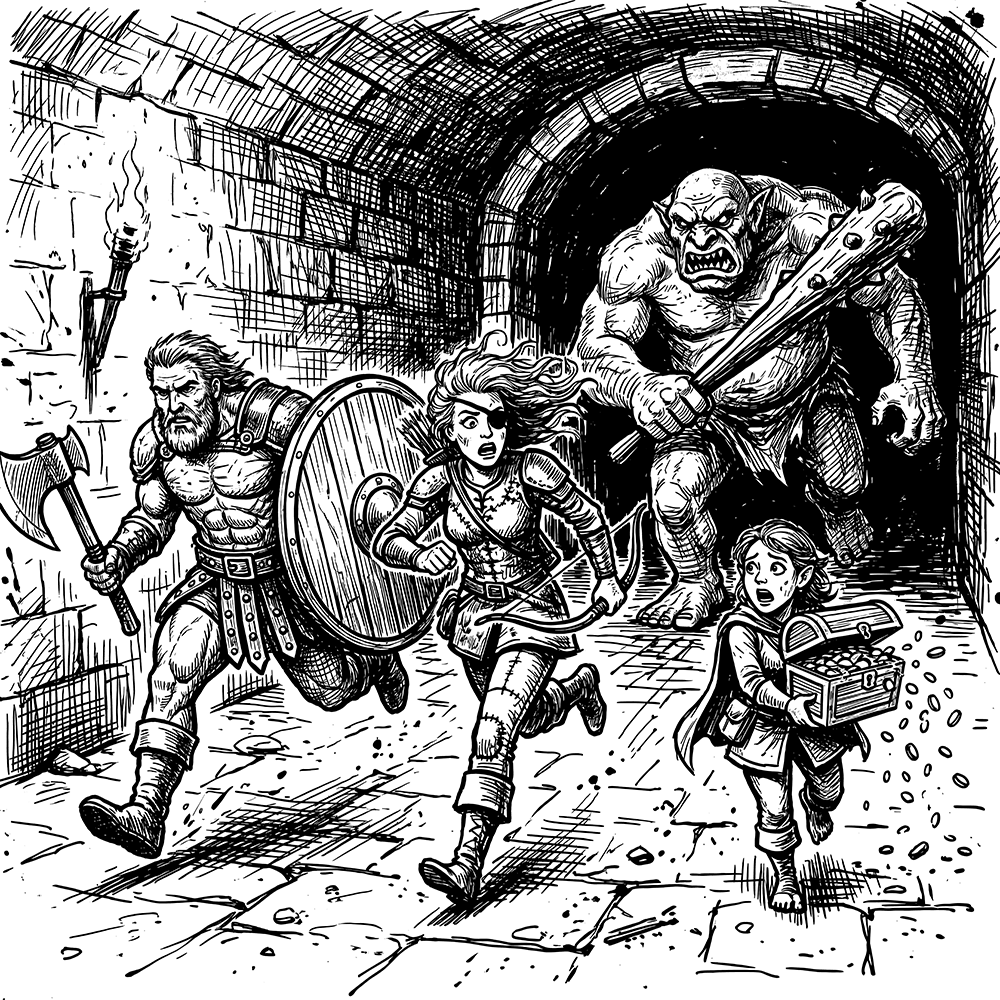
Now consider an encounter with a potentially lethal creature , say, a Mountain Troll. In an OSR game, head-on combat against such a creature is, nine times out of ten, a failure of intelligence or a desperate last resort. The mindset strongly encourages escape, negotiation, ambush, use of the environment (such as triggering a cave-in), or manipulation of other dungeon factions. Combat, when unavoidable, is chaotic, fast-paced, and brutally lethal. Each round is a dance with death, and tactical retreat is not only an acceptable maneuver but highly praised. In a modern game, an encounter with a troll is often a mainstay of the session, a meticulously prepared tactical puzzle. Players are generally expected to engage in combat, using their powers and actions synergistically and strategically to defeat an enemy that has, in most cases, been balanced to provide a “fair” challenge – difficult enough to be exciting, but surmountable with the intelligent use of the group’s resources. Fleeing is an option, but not the default; The system itself, with its vast array of actions, powers, and combat mechanics, encourages players to stand firm and fight, confident in their abilities.
When faced with the need to find a crucial clue hidden in the office of a corrupt nobleman, the difference deepens even further. The OSR group is compelled to interact with the environment in a granular and specific way. “I inspect the bookshelf, pulling each volume to see if any are fake or trigger a mechanism.” “I spill some of my wine on the Persian rug to see if the stain reveals a safe under the floor.” “I examine the mail on the desk with a magnifying glass, looking for watermarks or invisible writing.” The Game Master then reveals the information based on the accuracy and relevance of these stated actions. In modern play, it is common and accepted practice for the Game Master to call for an “Investigation” or “Perception” roll. A success on this abstract roll leads the Game Master to then deliver the clue: “After a thorough search, you find a secret compartment under the drawer, containing the incriminating letters.” The first method requires players to think as their characters would think, immersing themselves in the reality of the world. The second method relies on the character’s abstract competence to find the clue, allowing the game to progress more quickly toward the next plot point.
And finally, the moment of the Character’s Death . In the OSR mindset, death is often quick, anticlimactic, and serves as a stark reminder of the fragility of the adventurer’s life. “The spectral beam strikes you. You feel your life ebbing away. You’re dead. Who’s your next character?” Creating a new character is a deliberately fast process, focusing on basic stats, starting equipment, and a simple premise. Emotional attachment to the character is built organically through experiences lived in the game , not through an elaborate backstory written before the first session. In the modern mindset, death is a dramatic event of great weight. Mechanics like “dying states,” narrative resource points (such as “Heroism Points” or “Destiny”), or the GM’s own discretionary intervention can soften the fatal blow. If death does occur, it is likely to be at a moment of great narrative significance, perhaps a heroic sacrifice to save the group or at the climax of a long rivalry. Creating a character is a longer and more involved process, which includes talent selection, defining complex origins, establishing bonds with other characters, and building a detailed personal history. This process, in itself, encourages an immediate and deeper attachment, making the loss potentially more impactful, but also rarer.
Convergence Zones and the Fluid Spectrum: Beyond the Binary
It is extremely important to avoid the trap of thinking of this division as a binary war, with distinct armies and well-defined borders. The contemporary RPG landscape is a vast and fluid spectrum, where influences mix and lines blur. Many modern groups and systems consciously incorporate ideas and principles from OSR, and vice versa. D&D 5e itself , the epitome of mainstream modern RPGs, includes in its Dungeon Master’s Guide advice that sounds remarkably old school, emphasizing “Judgments, not Rules” and encouraging Dungeon Masters to move away from tables when the narrative demands it. On the other hand, many games at the forefront of the OSR scene, such as Into the Odd or Mörk Borg , employ a radical simplification of mechanics and a bold aesthetic design that is both a tribute to old school principles and a profoundly modern and innovative approach.
Furthermore, the game mindset is not an irrevocable dictate of the chosen system. It is perfectly viable, and even common, to play D&D 5e with a strongly OSR mindset: emphasizing exploration, lethality, player problem-solving, and the Dungeon Master’s impartiality. Similarly, it’s possible to take an OSR system like Old-School Essentials and play it with a more “modern” sensibility, focusing on pre-planned epic plots, protecting the characters as protagonists of a cohesive story, and giving great weight to their backstories . The key to a successful and frictionless campaign, therefore, lies in clear communication and the “Session Zero,” where the group must align not only the house rules but, more importantly, expectations and the flavor of the experience everyone wants to share.
Conclusion: Choosing Your Own Adventure in a Universe of Possibilities
In conclusion, this analysis makes it clear that the supposed debate between OSR and modern RPGs is not a battle to be won, but an invitation to a deeper exploration of the hobby’s possibilities. The fundamental question every group should ask itself is not “Which system or mindset is objectively superior?”, but rather “What kind of fun, challenge, and emotional experience are we seeking to share at this table?”
Do you and your group crave a sense of tangible, imminent danger? The thrill of discovering the truly unknown, where every step could be your last? The profound, almost visceral, satisfaction of overcoming seemingly insurmountable challenges through sheer cunning, careful preparation, and a dash of luck? Do you wish to feel that every piece of gold, every experience level, and every magical artifact was genuinely earned with sweat, intelligence, and a healthy dose of fear? If the answer is yes, then the OSR mindset, with its unforgiving and coherent world, its relentless focus on player ingenuity, and its celebration of emergent history, will likely be your ideal safe haven, an inexhaustible source of rewarding challenges.
On the other hand, do you and your group dream of living an epic and cinematic narrative, where you are the architects of destinies and the protagonists of legends? Does the fun for you lie in deep character development, moments of high drama, the exploration of complex themes, and the collaborative construction of a story with a memorable beginning, middle, and end? Do you seek the fantasy of heroic power, the confidence in special abilities, and the assurance that the journey, however arduous, will lead to a satisfying and meaningful climax? If so, then the mindset of modern RPGs, with their focus on narrative, heroism, and the curation of an emotional experience, will resonate more deeply and powerfully with your group’s desires.
Both approaches are legitimate, nuanced, and deeply rewarding ways to engage in the world’s most creative and flexible hobby. They cater to different angles of the human psyche, different appetites for challenge, and different modes of social enjoyment. One does not invalidate or diminish the other; they simply offer alternative routes to the same fundamental destination: the creation of shared and unforgettable memories. Therefore, the next time you sit down at the table, look at the iron gate not as an obstacle with a single correct solution, but as a symbol of two philosophies. It can be an intricate physical puzzle to be solved with creativity and teamwork, or it can be a dramatic portal to the next scene of a collaborative epic, opened with the triumphant roll of a die. The choice, as always, is yours, collective and sovereign. And it is precisely in this freedom of choice, in this vast and generous spectrum of possibilities, that the true and eternal magic of RPGs resides.