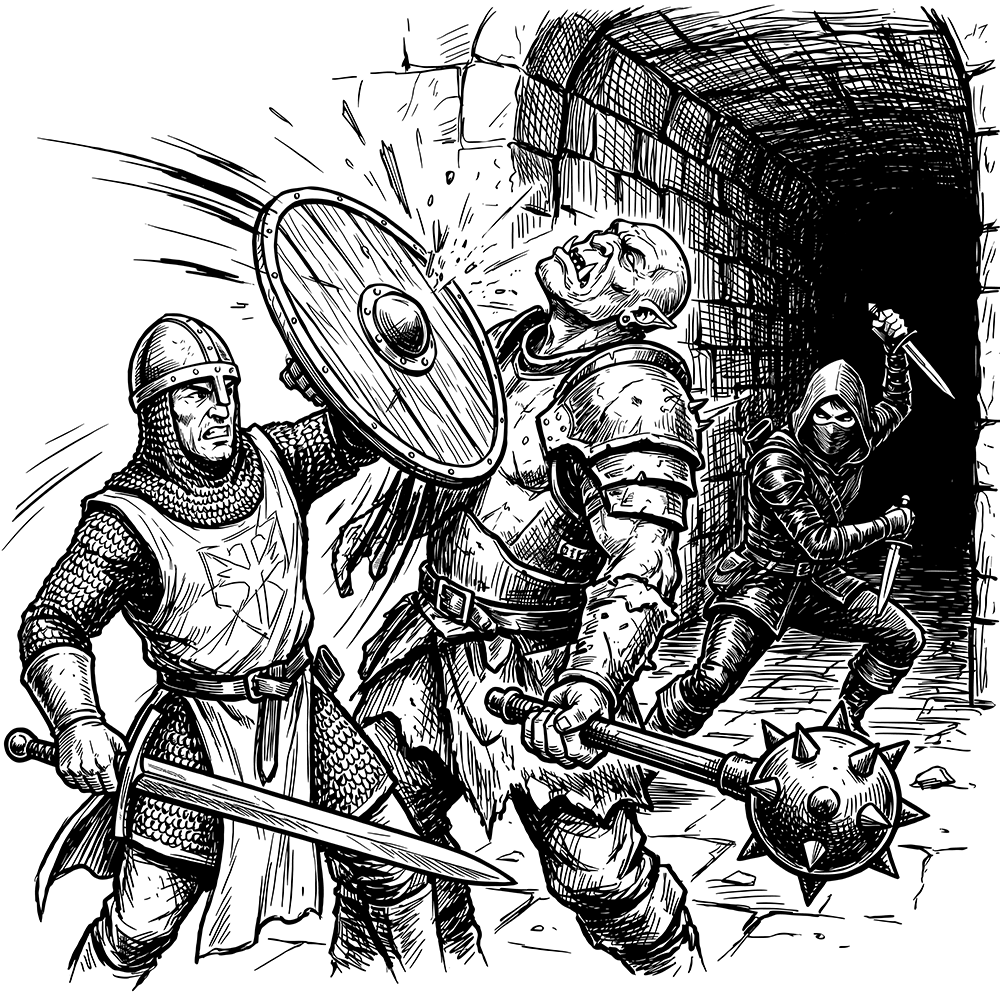
Beyond “I Attack”
Combat is often a central pillar of the RPG experience, a moment where tension reaches its peak and dice rolls decide the fate of daring characters. However, for many OSR groups, the routine of combat can degenerate into a monotonous succession of declarations: “I attack,” “I roll to hit,” “I deal my damage.” The cycle repeats, round after round, until one side falls. The narrative richness and tactical creativity, so celebrated in dungeon exploration and social interaction, seem to evaporate the moment swords are drawn. This article proposes an elegant solution, true to the OSR spirit, to this dilemma: the implementation of dynamic maneuver arbitration that transforms combat from a mere arithmetic exercise into a stage for meaningful decisions and emergent narratives, all without hindering the game with excessive or complex rules.
The philosophy behind this proposal is radically simple: the goal is not to create a new parallel combat system with endless lists of feats and talents that players must consult. On the contrary, it is to free players from the character sheet and encourage them to describe their intentions vividly and creatively. The suggestion is a guide, not a straitjacket. The essence of this method lies in two fundamental pillars: the Attack Sacrifice and Opposing Attribute Tests. The first principle establishes a clear cost for tactical ambition. Nothing is free. If a player wishes to achieve something more impactful than a simple strike, they must forgo the reliability of their normal attack. They are essentially betting that the tactical effect of the maneuver will be worth more than the guaranteed damage it could inflict. This cost inherently creates tension and difficult decisions, crucial elements for an engaging game.
The second pillar, Opposing Attribute Tests, is the universal resolution tool that maintains simplicity. Instead of creating a rule table for every possible situation, the Game Master simply translates the player’s description into an attribute conflict. An aggressive shove becomes a Strength vs. Strength test. A subtle attempt to disarm is a Dexterity vs. Strength test. A lunge to intimidate the opponent in the heat of battle could be Charisma vs. Wisdom. This approach is incredibly powerful because it rewards description and prioritizes narrative logic over mechanical logic. The system doesn’t ask “what skill are you using?”, but rather “what is your character trying to do?”. This subtle shift in perspective is transformative, encouraging players to think of the battlefield as a physical and social space, not a spreadsheet.
Let’s delve into specific maneuvers, starting with Control maneuvers, which prioritize altering the enemy’s state over direct damage. The Push is a classic example. A player, facing a gladiator at the top of a steep staircase, declares: “Instead of attacking, I’ll charge at him, trying to push him down the steps.” The Game Master, instead of consulting a rulebook, instantly establishes the cost: “You sacrifice your attack. Make a Strength check against his Strength.” The player rolls their d20, adds their Strength modifier (or rolls under and wins the larger difference), and the Game Master does the same for the gladiator. If the player wins, the gladiator is forced to retreat and may even fall, potentially suffering fall damage. Failure, however, means the player wasted their turn on a useless charge, leaving themselves exposed. Disarm works similarly. Against a powerful boss wielding a magical weapon, a cunning player can shout: “I’ll use my sword blade to hook his sword guard and snatch it from his hands!” Attacker’s Dexterity check against target’s Strength. Success instantly transforms a dangerous fight into a much more manageable situation. Failure leaves the hero in a terribly vulnerable position.
Grappling or Immobilizing is a high-risk, high-reward maneuver, perfect for the fighter seeking to neutralize a dangerous mage in the back of the enemy formation. “I lunge at him, attempting to immobilize his arms so he can’t gesture!” is a statement that triggers a Strength vs. Strength check. Success traps the target, possibly negating their actions or forcing them to spend turns trying to break free. But what if it’s an ogre? Grabbing an ogre is a terrible idea, and the system naturally demonstrates this through the likely difference in Strength modifiers. The Create Opening maneuver is perhaps the most collaborative of all. A player, noticing that their rogue ally is positioned for a backstab, might declare: “I’ll feign a high attack to distract him, while I stomp hard on his foot!” The DM might call for an Intelligence check (for a clever trick) or Charisma check (for devastating intimidation) against the enemy’s Wisdom. Success doesn’t cause damage, but it grants the next ally to attack that creature a significant advantage, such as a +2 bonus to attack or an advantage. This teaches players to think as a team, coordinating their actions for the greater good.
But what about when damage is necessary, yet needs to be applied more intelligently? This is where Offensive Maneuvers come into play, offering options that alter how damage is inflicted. The Heavy Blow is the embodiment of a desperate attack or outright fury. A dwarf, seeing his companion fall, might growl: “I completely ignore my defense and deliver an axe blow with all my might to the orc’s skull!” The cost is a severe attack penalty, something like -4 or -5. The player is essentially trading the chance to hit for the promise of devastating damage if the blow connects. The sound of the damage dice being rolled and doubled is a moment of pure catharsis at the table. On the other hand, the Double or Quick Attack is a display of speed and technique. An elven swordsman, facing an agile opponent, might opt for a flurry of smaller blows: “I’ll attack twice quickly, trying to find a gap in his guard!” Here, he makes two attacks, but each with a penalty, say -5. If both attacks hit, the total damage can be impressive. If only one hits, the damage is mediocre. If both miss, it was a wasted effort. This maneuver is excellent for testing enemies with low Armor Class or for finishing off heavily wounded opponents.
For situations where the player is surrounded, the Area Attack is the ideal tool. Imagine a barbarian with a large battle axe in the middle of a horde of weak skeletons. “I spin with my axe, sweeping the area around me!” The GM can decree that he makes a single attack roll, but with Disadvantage, representing the challenge of hitting multiple moving targets. A success means that each adjacent skeleton is hit. The damage can be normal or, for balance, a fixed and reduced value, such as 1d6. Failure, however, is catastrophic: the hero spent his turn spinning uncontrollably and now all the enemies around him can have advantage against him on the next turn. This maneuver is perfectly thematic and resolves with a single dice roll what, in other systems, would take ten minutes.
The crown jewel of this approach, however, is Targeted Attacks. This is the ultimate manifestation of player creativity and GM’s discretion. It allows players to target specific parts of an enemy’s body for a tactical effect, accepting a monumental risk to do so. The attack penalty here should be severe, somewhere in the range of -6 to -8, reflecting the extreme difficulty of hitting a tiny, well-defended spot in the heat of mortal combat. The process is simple: the player describes what they want to do, and the GM determines the effect if successful. An exhaustive catalog isn’t necessary, but rather a shared understanding of the logical consequences. For example, a player declaring “I’m going to aim for the knight’s legs with my mace!” is clearly trying to impede their movement. If successful, in addition to normal damage (or instead), the GM can decree that the knight is knocked down, lying on the ground, or that their movement speed is halved for the remainder of the combat. The sound of bone breaking is implied in the narrative.
An attack to the arms or hands, such as “I’ll try to cut the tendon of the arm holding the lich’s staff!”, is obviously aimed at neutralizing the enemy’s offensive capabilities. Success could disarm the lich, forcing him to pick up the staff again as an action, or it could simply deny him the use of two-handed attacks or the shield bonus. A blow to the head or face, “I’ll go for his face with my fist, trying to stun him!”, is a classic attempt to break concentration. Success can leave the enemy Stunned for one round, causing him to lose his next action. This is incredibly valuable against magic users. Finally, the riskiest attack of all: the eyes. “I’ll throw dust from the ground into the goblin’s eyes!” or “I’ll try to stick my dagger in the cyclops’ eye!” Success here can temporarily blind the enemy, granting everyone advantage on attacks against him until he can recover. The key is that the Game Master should be encouraged to be creative and shape the effect based on the player’s description and the logic of the situation. A blow to a harpy’s wings could take away its ability to fly. An attack on a scorpion’s tail could disable its stinger.
The real beauty of this approach is that it doesn’t need to be presented to the players as a formal document. It can be introduced organically, in the heat of the moment. Suppose a player describes an action that isn’t a simple “I attack.” Let’s say they say, “I want to jump off the table and land on the captain of the guard!” A traditional Game Master, without a framework for this, might be perplexed. But with this philosophy, the response is immediate. The Game Master can say, “Okay, that sounds like a Grapple maneuver, but with style. You’re going to sacrifice your attack. Roll a Dexterity check against his Strength. If you win, you knock him down and get on top, immobilizing him. If you lose, you jump straight for his ready blade.” This immediately validates the player’s creativity and transforms a colorful description into meaningful mechanical action.
For groups desiring a deeper degree of customization, the “Specialist” Rule can be introduced. This optional rule allows characters, through training and experience, to become truly proficient in a specific maneuver. After a remarkable feat or spending time and gold training with a weapons master, a character can reduce the penalty of a chosen maneuver by 1 point. A swordsman specializing in Disarm, for example, would have a smaller penalty than a novice attempting the same feat. Further specialization could reduce the penalty even further, making the maneuver almost as reliable as a normal attack. This adds a layer of vertical progression without complicating the system for other players and without the need for predefined classes or archetypes. The hero is defined by their actions and where they choose to invest their training, not by a list of class powers.
The benefits of adopting this approach are multifaceted. First, it returns narrative agency to the players. They are no longer passive spectators of their own attacks; they are the choreographers of their own effectiveness in battle. Each turn becomes a small story, a micro-narrative of risk and reward. Second, it significantly elevates the tactical value of combat. Suddenly, positioning, the state of enemies, and coordination with allies become critical factors. It’s no longer about who has more hit points, but about who can control the flow of the conflict. A group that uses maneuvers creatively can defeat enemies far more powerful than their level would suggest.
Third, and perhaps most importantly, this approach creates unforgettable memories. No one remembers the fortieth “I attack” that killed a goblin. But everyone will forever remember the day the halfling, facing an ice giant, accepted an -8 penalty to leap and plunge a dagger into the creature’s eye, blinding it and turning the tide of battle for the group. This is the essence of OSR: emergent stories born from simple rules, bold creativity, and audacious dice rolls. Combat ceases to be an obstacle and becomes an opportunity, the forge where legends are made. By inviting players to go beyond “I attack,” we are not only making the game more interesting; we are reaffirming the heart of what makes RPGs a unique art form: the power of shared imagination to create something truly epic.