How the OSR Community Really Plays
In the world of RPGs, few movements are as surrounded by principles repeated ad nauseam as the Old School Renaissance (OSR). Phrases like “combat is a state of failure,” “combat as war, not as sport,” and “the mage is not useless because he can throw daggers” are recited in forums, blogs, and videos as if they were commandments from an unwritten manual. But do these statements reflect the reality of the game table? Or are they idealizations born from the so-called “blogification” of OSR?
At the end of 2025, a Reddit user – u/Doomblade666 – asked exactly that question on the subreddit r/osr. In a post titled “How does the community really play their OSR rpgs,” he asked members to describe their actual practices, moving beyond common sense. The responses, more than fifty detailed comments, reveal a much richer, more diverse, and sometimes contradictory landscape than the slogans suggest.
This article analyzes the content of that topic, drawing lessons on how the OSR community actually plays – and, more importantly, how it critically reflects on its own dogmas. The source is primary: the voices of active game masters and players, not theorists or digital influencers. In the end, we will see that OSR is less a set of fixed rules and more an adaptable attitude, where each group builds its own version of what it means to “play the old-school way.”
How do we analyze the discussion?
The original post received dozens of responses, many of them long and detailed. The author of the question also compiled basic statistics from the initial responses, which I have included here. For this analysis, I conducted a qualitative reading of the most upvoted and most substantive comments, identifying recurring themes, points of disagreement, and concrete examples of play styles.
This is not a scientific study with a representative sample, but rather a valuable snapshot of the active Reddit community – composed mostly of experienced GMs, many with decades of practice. The richness of the accounts allows us, at the very least, to question the universality of OSR clichés.
Clichés under scrutiny
Let’s start with the four statements that the post’s author listed as “frequently repeated,” comparing them with accounts from the community.
“Combat is a state of failure”
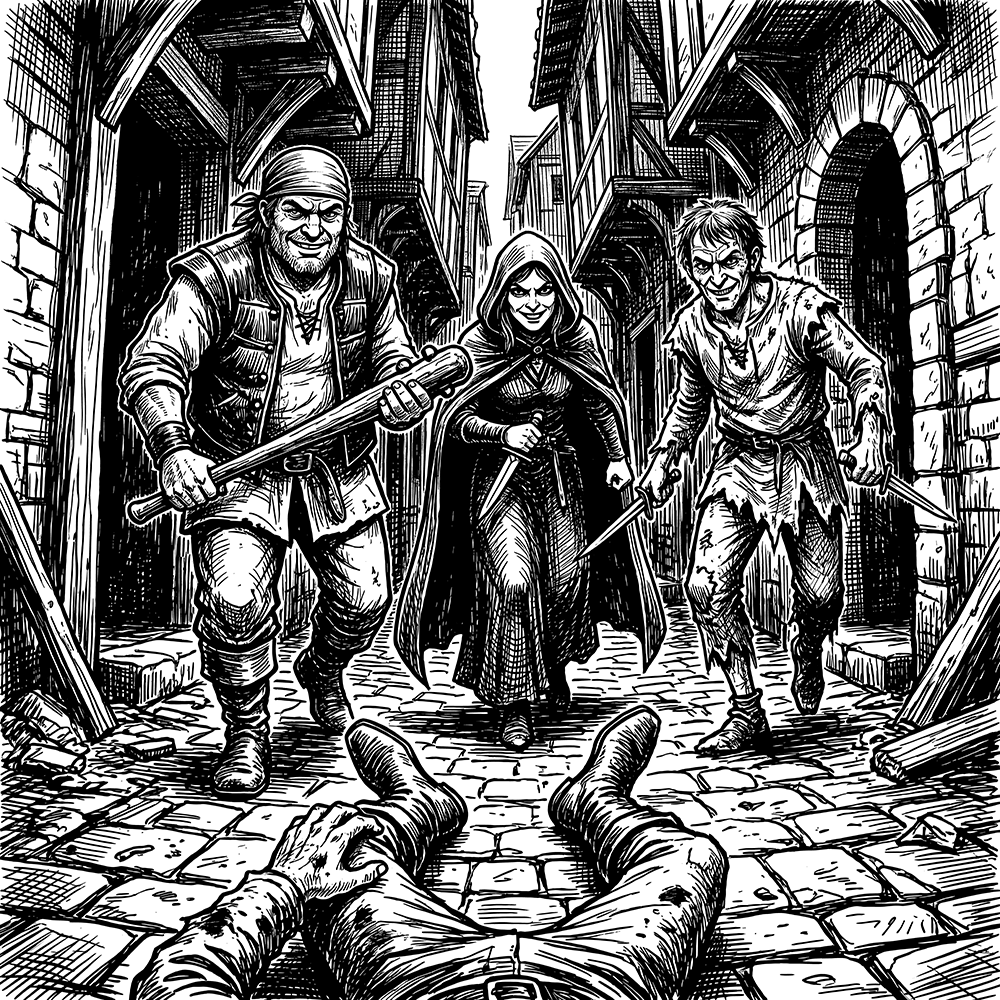
This is perhaps the most controversial phrase in the entire thread. The consensus that emerges is clear: it’s an exaggeration . User VendettaUF234, one of the most upvoted, summarizes: “I think combat as a state of failure is an exaggeration, in my opinion. It’s dangerous, but also fun.” Another member, Enough-Run-1535, recalls his experience in the 80s/90s: “My players would start fights with anything and everything, like fearless elementary and high school kids do.”
The nuance appears in several comments. What many mean by “state of failure” is actually “fair combat without preparation is a state of failure .” User c0ncrete-n0thing explains: “The world won’t offer you challenges appropriate to your level […] Rushing in with your sword in every encounter is a choice, but it will kill you sooner or later.” User OriginalJazzFlavor is even more direct: “Fair combat is a state of failure. Two sides rolling initiative without the players having done anything to balance the scales in their favor.”
The vast majority of respondents reported having 1 to 3 combat encounters per session , and several said that combat is a fun and anticipated part of the game. A comment by alphonseharry summarizes: “But, as you said in your last paragraph, combat as war is not ‘without combat’, but just how I tip the scales to gain an advantage in combat.”
Therefore, the original statement is false if taken literally, but true in its more subtle intention : combat without advantage is too risky. In practice, OSR tables do fight – but they fight intelligently, or at least they try to.
“Combat as war, not as sport”
This statement is much more widely accepted. It doesn’t deny combat; it merely defines its nature. User Past_Plankton_4906 criticizes YouTubers who “make it seem like low levels, where you don’t fight unless you have to, are not only fun, but the ONLY way to play.” However, even he doesn’t reject the principle that combat should be treated with tactical seriousness.
Several respondents gave examples of how they apply this: ambushes, use of terrain, recruitment of temporary allies, escape when things get tough. User ThatDemiGuy described a session where the group “turns a conversation into an ambush” by retreating, observing the enemy, and returning with a plan.
The essence of “combat as war” is the rejection of sport combat – the kind where two sides line up in an open field and exchange blows to the death, with “balanced” encounters. In real OSR, players seek any advantage, no matter how dirty. And so do the monsters.
“The magic user is not useless, because he can throw daggers.”
This statement was almost unanimously ridiculed. Not because mages are useless, but because the argument is shallow. The usefulness of a low-level mage comes from several fronts:
- Impact Spells : Sleep is cited by dozens as the great equalizer at level 1. One user joked: “wizards are a sleep grenade you throw once a day”.
- Uses outside of combat : detect magic, read ancient languages, negotiate with intelligent creatures, solve arcane puzzles.
- Threat perception : intelligent monsters may fear a mage even if he is weak, opening up opportunities for bluffing.
- Indirect support : holding a torch, carrying treasure, activating magical devices.
The author of the post himself noted that, in games where the initial spell is random, a wizard who rolls Read Magic is really reduced to throwing daggers. Therefore, many game masters use alternative rules: wizards start with a basic spellbook, or use systems like Shadowdark (roll to cast, no fixed spell slots) or DCC (chaotic and powerful magic).
The lesson here is that the cliché attempts to defend a real design flaw (level 1 mages being too fragile) with a weak argument. The community, in practice, resolves this with rule adjustments – not with speeches.
“Old school is about resource management and exploration.”
This was the most widely accepted statement – but with important caveats. Exploration is central: megadungeons, hexcrawls, mapping, route decisions. User skalchemisto summarizes: “Exploration is incredibly important; it’s the main point.”
Regarding resource management, there is variation. Many track torches, rations, arrows, coin weight, and even dungeon turn time. Others find the accounting tedious and simplify things. One user, Victor3R, said: “Equipment, gold, and inventory slots are important. But I find rations less interesting. Outside of deep dives and several days in the unknown, it’s a lot of accounting and wasted rubber for little return.”
Another interesting point: resource management isn’t just individual. User clickrush notes that “resource management in OSR is largely shared or can be shared (like gold, rations, arrows), as opposed to being just individual resources (like spell slots or N/day abilities), which encourages group planning and interaction.”
Therefore, the statement is true in spirit, but flexible in execution . Each table decides the level of detail that is enjoyable for them.
Real diversity: numbers, systems, and styles.
One of the biggest takeaways from the post is that there is no single “OSR way .” The author’s compilation revealed:
- Most cited systems : OSE, Shadowdark, Dolmenwood, DCC, Worlds Without Number, B/X, AD&D 1e, Mausritter, Cairn, Troika.
- Group size : average of 3 to 7 players (with variations from 2 to 12).
- Preferred classes : Warrior and Mage are very common; Cleric and Thief also appear. Many groups use helpers or reserve characters.
- Frequency of combat : 0 to 5 per session, with most between 1 and 3.
Some groups play “pure” OSE with all the procedures; others mix rules from different systems. One user, Droselmeyer, reported running Shadow of the Weird Wizard (a non-OSR system) with OSR principles – no fixed classes, but with inventory management, random encounters, and gold for XP. This shows that OSR is more of an arbitration style than a set of rules.
Another relevant piece of data: the majority of respondents are game masters (GMs) , not players. The author of the post noted this in the statistics: “It seems that many of you are game masters and fewer are players.” This may bias the responses towards a more “idealized” view of the game, but it also means that the accounts come from those who have practical experience in running games.
A critique of “blogification” – theoretical OSR vs. real OSR
Several comments raised an important point: many OSR slogans don’t come from the practice of trading desks in the 80s/90s, but rather from blogs and YouTube channels that emerged later. User BusinessOil867 is emphatic:
“Combat is a state of failure” is basically removing the “old school” from “OSR” and shows that at least some parts of OSR are reading too many blogs and watching too many YouTube channels and not rolling enough dice. […] Old School D&D wasn’t (for the most part) a story-driven game […] It was about exploring the space between location-based adventures. Once you got there, the fun was in killing the monsters. Not in talking to them.
User Enough-Run-1535 corroborates: “If there’s one thing, growing up in the ’80s and ’90s, my friends and gamers treated OSR combat more like a war game than a state of failure.”
This disconnect between the theory propagated online and historical (and current) practice is crucial. “Blogging” has created a purist and exaggerated version of OSR, which intimidates newcomers and ignores the diversity of styles that has always existed. The author of the post himself seems to have realized this when asking whether the common claims are true “or if they come from an idealization”.
The upside is that the community on Reddit is doing a healthy job of self-criticism . It not only rejects clichés but also offers detailed alternatives.
What really matters
With the clichés removed, what are the truly central elements for most OSR tables, according to the post?
Exploration as a driving force
Almost all respondents placed exploration (of dungeons, wastelands, cities) as the heart of the game. User Teid described an unforgettable session where “1 player orchestrated a massive, logistics-driven operation to extract 20 rare statues from a floor […] The only combat was with a Wyvern that the druid held in place.” Exploration, not combat, generated the fun.
Real-world consequences and living worlds
Random encounters, reaction rolls, and tables of wandering monsters make the world feel independent of the PCs. One user, 1001Smites, describes how he pre-rolls all the session’s random encounters – distance, creature activity, reaction, surprise – so that the world reacts consistently. This generates emergent situations, such as cultists who are initially hostile and can become allies depending on the roll.
Player skill above the token.
Several comments reinforce the idea that “the answer isn’t in your character sheet”—but with the nuance that the items and spells on the sheet are tools , not automatic solutions. User rrizzlybear explains: “Your character sheet isn’t a list of solutions your character can use, it’s a list of things you, the player, must protect.”
In practice, this means that a creative player can use a simple crowbar in ways that no skill could cover. A wizard without spells can still pour oil on the ground and set it on fire. The cliché is true in essence, but it’s misinterpreted when used to justify omissions in the rules.
Lethality, but not gratuitousness.
Character death is common, but most game masters signal the danger. User grumblyoldman says: “My players may die, but it won’t be because I didn’t signal the danger to them.” Lethality is a consequence, not a goal. And when a character dies, the solutions are varied: a new character at the same level, one level below, or promotion of a helper.
What does the community disagree on? Internal tensions
Not everything is agreed upon. The post reveals some interesting divisions:
- Combat procedures : some use phased combat (B/X style), others find it confusing and prefer action systems. Victor3R abandoned phases because “spellcasters never want to cast spells because they are so afraid that their few meaningful actions will be interrupted.”
- Severity of resource management : while many count every torch, others find it boring and ignore it. There’s no shame in that – each table finds its own level.
- XP for gold vs. XP for combat : most use XP for gold, but some game masters give XP for significant combat.
This diversity is healthy. It shows that OSR is not a cult with a single set of rules, but rather an umbrella of approaches that share some families of systems and a general attitude.
OSR as an attitude, not as dogma.
What can we learn from this post and its responses? Three main lessons:
First lesson: OSR clichés are useful shortcuts, not universal truths. “Combat is a state of failure” serves as a warning against overconfidence, but in practice, tables fight – a lot. “A mage is not useless” is true, but for far more interesting reasons than “throwing daggers.” The secret is to use slogans as starting points for reflection, not as ironclad rules.
Second lesson: diversity is the true hallmark of OSR. There are as many “OSRs” as there are tables. Some play pure OSE with torch counting; others use Shadowdark with flexible magic rules; still others adapt OSR principles to non-OSR systems. The important thing is that each group finds the balance between challenge, exploration, and fun – without worrying about meeting external expectations.
Third lesson: the OSR community is maturing and self-criticizing. The fact that the original post received dozens of detailed and reflective responses – many of them criticizing the movement’s own dogmas – shows that OSR is not an echo of influencers. It is a living community that plays, tests, and adapts. Which leads us to the most important point:
OSR is not a set of rules. It’s an attitude. It’s the willingness to let the game world react naturally to the players’ actions, to not balance encounters, to value creativity over dice rolls. It’s the acceptance that characters can die and that this doesn’t ruin the story – on the contrary, it creates memorable stories.
For the beginning game master, the advice from the veterans in the post is clear: ignore the clichés and start playing . Use a simple system (Basic Fantasy, OSE, Shadowdark), put the players in a dungeon, roll random encounters, and see what happens. Over time, your own style will emerge – and it will be just as legitimate as any described in this article.
As user alphonseharry said: “There is no universal answer to these questions. Each group has different interpretations.” And that, perhaps, is the greatest wisdom that OSR has to offer. OSR is not a dogma, it is a movement, a movement that “moves,” evolves. It is more like a philosophy.
References: The content analyzed is available in the archive of the post “How does the community really play their OSR rpgs” on the subreddit r/osr, published in 2025. Usernames and citations have been preserved for accuracy, but the opinions are those of their respective authors.