An Alternative to Vancian Magic
The heart of the Old School Renaissance (OSR) movement has always been the sword, the torch, and the cracked clay of a dark dungeon. But its soul, what truly pulsates beneath the shell of data and tables, is a voracious hunger for possibilities. After years of dominance by the “Vanciano” magic system of Dungeons & Dragons , many players and creators within the OSR began to feel that the flame of magical wonder had become a bottled-up flame, cataloged on shelves. It was then that many eyes turned to a distant beacon, coming from another tradition: the fluid, creative, and almost academic magic of Ars Magica . This article examines the origins of this restlessness, the philosophy behind the search, and, above all, the many bold, and sometimes frustrated, attempts by the OSR community to transplant the soul of Ars Magica magic into their minimalist systems.
Magic as a Mechanism and Magic as a Language
To understand the appeal of adaptation, it is first necessary to understand the conceptual chasm that separates the two systems. The first, and most familiar, is the “Vancian” magic system from the early editions of D&D. Named after the author Jack Vance, whose novels The Dying Earth inspired it, this system treats magic as a limited and almost physical resource. The wizard must study his spellbooks every morning and memorize a specific number of spells, which occupy “magic slots” in his mind. When cast, the magic literally dissipates from the caster’s memory, like an arrow fired from a mental quiver. To cast the same spell again, it is necessary to have memorized it multiple times or go through a new period of study.
In this paradigm, magic is powerful and, in theory, dangerous, but the spellcaster’s main limitation is accounting and logistics: how many spells of each level can he “carry” per day? The practical consequence is that the wizard becomes a bag of pre-selected tools. Creativity arises in choosing which tools to take on the adventure, not in their flexible application in the heat of the moment. It is a system that, despite its tactical charm, imprisons a spellcaster’s potential in a rigid list of predefined effects.
In contrast, the magic system in Ars Magica is less a crossbow-shooting mechanic and more a grammar for constructing a language. Its core is the famous “Verb/Noun” system, formalized as the 15 Arts: 5 Techniques (the verbs) combined with 10 Forms (the nouns). The Techniques define the magical action; they are: Creo (Create), Intellego (Perceive), Muto (Transform), Perdo (Destroy), and Rego (Control). The Forms define the target of the magic: Animal , Auram (Air), Aquam (Water), Corpus (Body), Herbam (Plant), Ignem (Fire), Imaginem (Image), Mentem (Mind), Terram (Earth), and Vim (Power).
By combining a verb with a Latin noun, the theory allows a magus to create virtually any imaginable effect. To cast a simple fireball, a mage could use Creo Ignem (Create Fire) to generate the flame from nothing, Rego Ignem (Control Fire) to hurl an existing flame, or even Perdo Ignem (Destroy Fire) to create a region of extreme cold. Magic in Ars Magica is not a shopping list; it’s a real-time problem-solving tool. If the player can articulate the desired effect in terms of a Technique and a Form, the system provides (albeit complex) guidelines to assess how difficult it would be to achieve that feat.
Why does the philosophy of Ars Magica resonate with OSR?
At first glance, comparing Ars Magica , a system often described as heavy and complex, to the “rulings not rules” philosophy of OSR seems counterintuitive. However, the relevance of the idea lies in a deeper aspect than simply counting the pages of the rulebook. The OSR philosophy, which emphasizes the Game Master’s decisions rather than fixed rules and the player’s skill over the character’s abilities, sees rules as tools on the table, not as a prison.
The magic system in Ars Magica , by its very flexible nature, inherently relies on a human arbiter to function. There is no rule for “freezing the blood in an opponent’s bones.” Instead, the system provides a framework: Perdo Corpus (Destroy Body) for a lethal effect, or Rego Corpus (Control Body) for paralysis. The final difficulty, casting time, and any situational modifiers are decided by the Game Master, based on their understanding of the story and the logic of the world. This is the essence of “rulings not rules”: the rule provides a foundation, but the final decision rests with the Game Master to maintain the flow of the narrative and the sense of challenge.
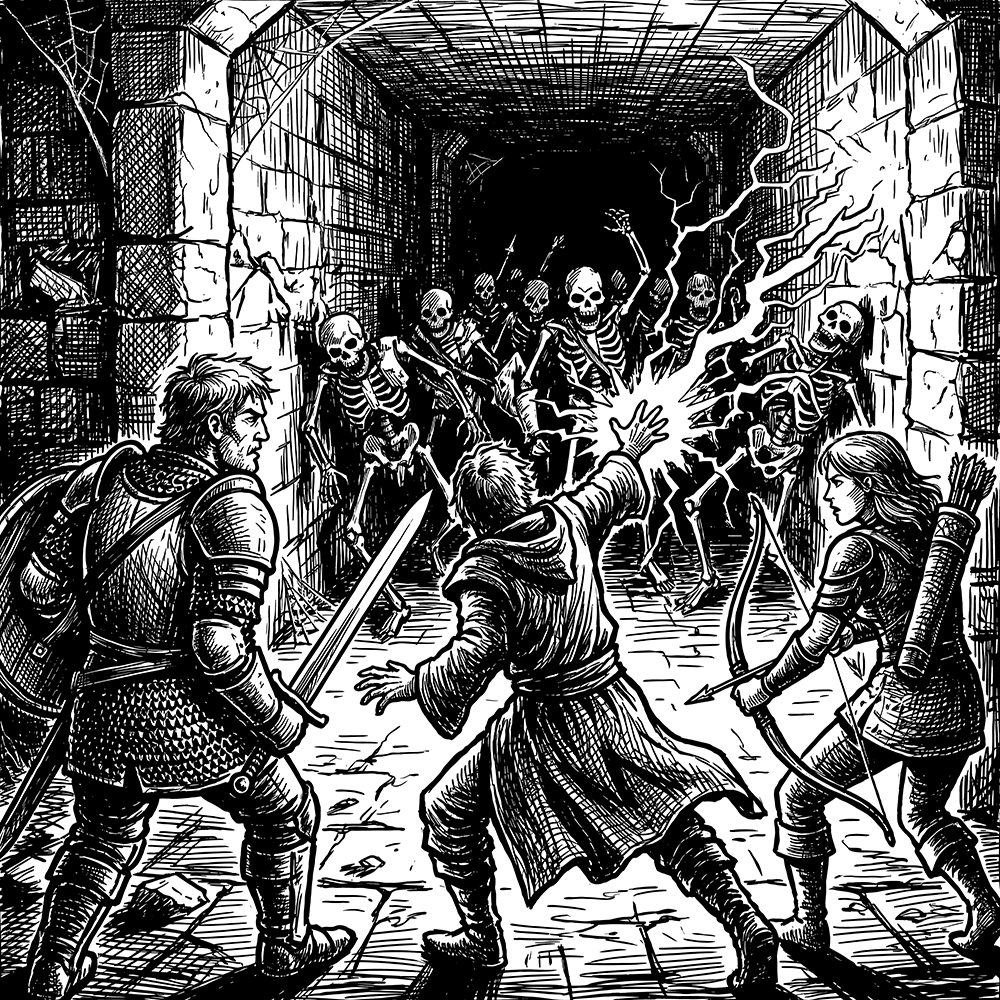
Furthermore, Ars Magica rewards the kind of creative and non-linear thinking that OSR so highly values. In a standard OSR game, a wizard might use a spell like Web to trap a troll. In a game with magic inspired by Ars Magica , the same wizard might have the idea of using Muto Terram (Transform Earth) to weaken the ground beneath the troll’s feet or Intellego Animal (Perceive Animal) to discover that it is afraid of fire, and then use Creo Ignem to create a bonfire. The possibilities explode exponentially, getting closer to the feeling of being a “true” sorcerer trying to manipulate the laws of reality than a machine operator of effects. The structure of verbs and nouns serves as a “scaffold” for improvisation, preventing magic from becoming a succession of “I do magic!”, but at the same time, it doesn’t rigidly confine the action to a list of pre-approved options.
The Attempts, the Challenges, and the Hybrid Solutions
The story of the merging of these two philosophies is, above all, a story of trial and error and ingenious compromises. From the outset, the community recognized that simply transplanting the complete rules of Ars Magica into a retroclone would not be a simple task, mainly due to the differences in time progression and resources. However, over the years, three main approaches have crystallized.
The first approach is that of direct structural adaptation. In this line of thought, creators attempt to maintain the core of Techniques and Forms, but reconstruct the mathematics of charges and penalties to fit the d20 systems of OSR. An emblematic example is ” Ye Olde Magick Hacke “. In this system, the author creates a General Skill for “Ars” (representing hermetic knowledge), with all the Techniques of Ars Magica as sub-skills, and another skill for “Morph”, with all the Forms as sub-skills. To cast a spell, the player would roll their skill in the relevant Technique plus the associated attribute, with the difficulty dictated by the Form and the complexity of the effect. Another interesting example arose in discussions about the Godbound system , an OSR game where the characters are demigods. One user proposed a “Heroic Talent” that transformed the character into a wizard in the style of Ars Magica , using a roll system Técnica + Forma + dado(like 1d10) against a difficulty dictated by the Game Master, with a fatigue accumulation system to limit the conjurer’s power, preventing them from becoming an omnipotent god.
The second approach, perhaps the most fruitful and popular, is the creation of “free” systems inspired by the philosophy of Ars Magica , but radically simplified. The premise here is to capture the feeling of free magic, but abandoning the complexity of the effect level tables of Ars Magica . One of the most cited examples is Giovanni’s “Freeform Magic System for OSR Games”. Instead of complex formulas that take into account damage, area, range, and duration, this system proposes only two questions that the Game Master must answer to assess the difficulty of an improvised spell: “What danger is this spell trying to solve?” and “How direct and complete is the solution desired by the mage?”. Another notable example is the optional class “The Conjuror”, mentioned on RPGGeek. Instead of spell slots, the Conjurer combines “Aspects and Processes” on the fly to create an effect. The creator states that the class is about improvisation, where the player must be creative and the Game Master must be able to make quick and fair decisions about the outcome.
Finally, the third approach involves the use of complete “hacks” or lesser-known retroclones that have already attempted to solve the problem. “The Conjuror” is one such product, available in stores like DriveThruFiction. It proposes a class that, instead of fixed spells, receives words that it can combine to create its spells. Another product, called “Eclipse: The Codex Persona Shareware”, offers a complex magic system that the author claims is “derived from Ars Magica ”, but with its own set of nouns and verbs, and a mana system to power the spells.
The Legacy of a Near-Conquest
So why don’t we see a massive proliferation of OSR systems using Ars Magica magic as a standard? The answer lies in the very nature of the challenge. The Ars Magica system doesn’t exist in isolation; it’s intertwined with a specific gameplay rhythm (study and research stations), with a system of experimental magic and the creation of new spells in the laboratory, and with an experience point system that rewards academic activity as much as adventuring. Trying to “weld” magic into an OSR system without taking these factors into account can result in an unbalanced mage or a system that doesn’t integrate well with the structure of a dungeon.
There is also the question of simplicity. Many successful OSR solutions for free magic, such as those mentioned, are extremely elegant, but can be so minimalist that the structure of verbs and nouns becomes almost superfluous, reduced to an improvised difficulty table. On the other hand, attempts to maintain the richness of Ars Magica ‘s 15 verbs and nouns with its 5 Techniques and 10 Forms quickly bloat the rulebook, going against the ethos of lightweight and portable OSR systems.
Ultimately, the OSR community’s quest for the magic of Ars Magica is less about commercial success and more about an ongoing creative dialogue between two great philosophies of RPG design. The legacy of this quest is not a single system that reigns supreme, but a rich collection of small experiments, forum hacks, and optional classes for those willing to break the mold of the wizard with his grimoire and ask his Dungeon Master: “What if I tried to create ice in the dragon’s heart?”. This question, and the willingness to find an answer through a flexible system, is perhaps the greatest victory of the OSR movement. And it clearly echoes the voices in the laboratories of the Order of Hermes.