Hexcrawl in the Dirty City
The classic image of an OSR-style campaign is that of a group of adventurers traversing desolate lands and subterranean labyrinths, where each hex on the map hides a threat or a wonder. However, there is an environment as dangerous, complex, and full of opportunities as the oldest forests and the most treacherous mountains: the city. Specifically, the dirty, decadent, and corrupt city, a living, diseased organism where savagery is encased in brick and law is a commodity for sale. Transplanting the principles of exploration and discovery from the hexcrawl to an urban environment is not only possible, but can generate some of the most memorable and rich OSR campaigns. This method, which we can call “Quartercrawl” or “Urban Crawl,” transforms the city from a mere backdrop or resting place into an open dungeon, a vast and systemic location to be explored.
The first step in this transformation is a change of mindset. The Game Master must stop seeing the city as a collection of shops and taverns and begin to see it as a hostile ecosystem and a political battleground. The same principles that govern a wilderness crawl apply here. The journey from one point to another is not automatic; it consumes time, resources, and is subject to danger. The unknown is not a dense forest, but a dark alley, a clogged sewer, or a district ruled by a rival gang. Exploration is rewarded with the discovery not of magical clearings, but of reliable informants, secret routes, and the dirty secrets that keep the powerful in control. The city is, in essence, a roofless dungeon, with its own levels of danger, its own resident monsters, and its own priceless treasures.
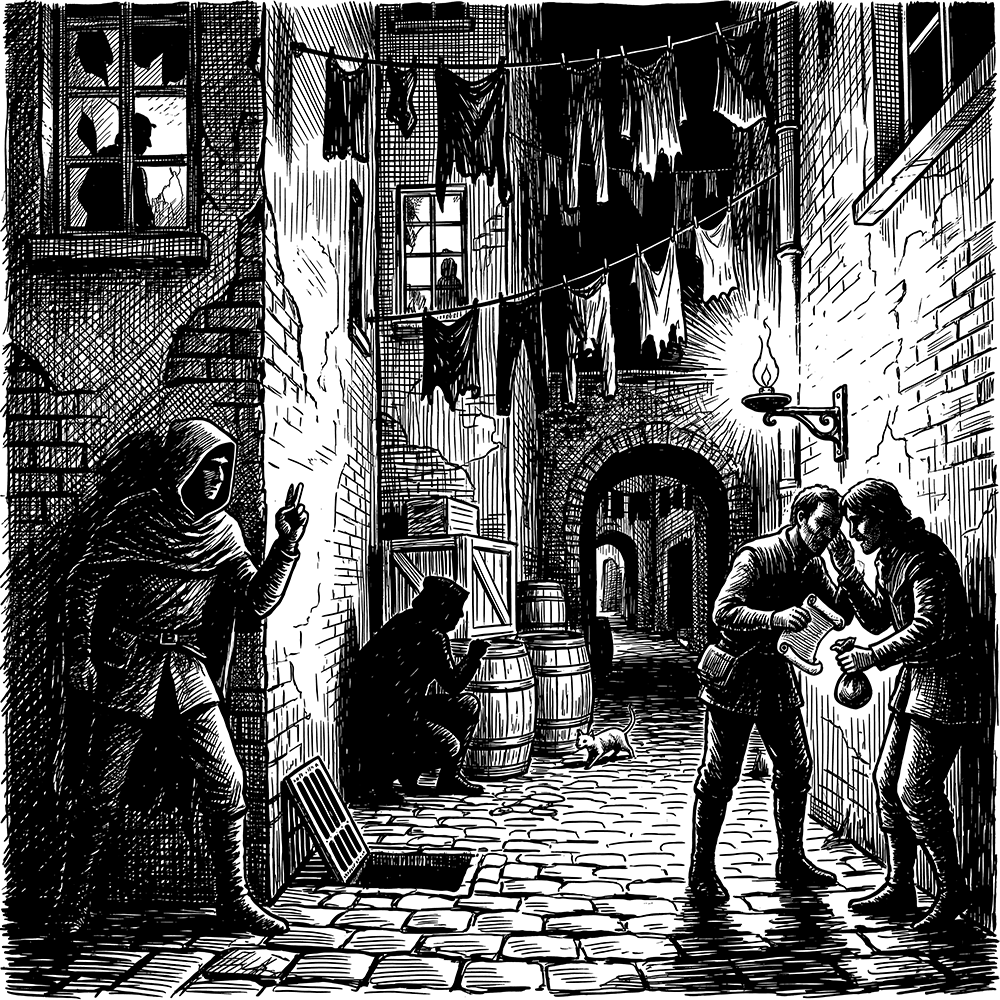
The backbone of any hexcrawl is the map, and for the dirty city, it’s even more crucial. Instead of a map of hexagons over a landscape, create a map of neighborhoods or districts. Each district should be treated as a large “hex,” with its own identity, danger level, and unique encounter table. The Port District isn’t simply a place with docks; it’s an undeclared martial law zone, controlled by the smugglers of the Sailors’ Guild, smelling of rotten fish and saltwater, where strangers are met with hostility and the City Guard rarely ventures. The Noble Quarter, on the other hand, is a gilded prison of laws and etiquette, where danger isn’t a knife in the dark, but a false accusation, a fabricated debt, or a duel of honor. The Sewers, of course, are a classic dungeon that snakes beneath all the other districts, a kingdom apart with its own rules and horrors. Drawing these boundaries and defining the personality of each area is the fundamental task.
Within these districts, the unit of exploration ceases to be the six-mile hexagon and becomes the city block. A detailed map of city blocks is the Game Master’s most valuable tool. Each block can contain one, two, or perhaps three “Points of Interest.” These points are not just shops; they are dynamic locations that drive the narrative. One point of interest might be the Fountain of the Drunken Boar, a notorious tavern that serves as a meeting point for the thieves’ guild “The Shadows.” Another might be the Sulinus Grain Warehouse, a front for a cult that worships a subterranean entity. A third might simply be a Neglected Cemetery, where the dead cannot rest in peace. The key is that most city blocks should be blank on the players’ map. They don’t know what’s around every corner. Physical exploration, asking locals, and the simple passage of time will fill in this map, just as they would with an unknown wilderness.
The pace of exploration is governed by Time and Resources. The city is vast, and traversing it on foot takes time. Establish that moving from one block to an adjacent one takes, for example, ten minutes. Crossing an entire district can take an hour or more. This means that a day in the city has a limited number of exploration “turns.” Players need to decide whether to investigate three blocks quickly or dedicate more time to a single point of interest. And, crucially, time passes. If the players linger too long, night falls, and the night city is a radically different and far more dangerous place. Resources like torches are replaced by money. Characters need to pay for food, lodging, and perhaps most importantly, information. Bribery, kickbacks, and the buying of favors are the primary currency in the dirty city. Managing the looted wealth from the dungeons becomes a constant pressure, a driving force compelling adventurers to keep taking risks.
No hexcrawl, urban or otherwise, works without the threat of randomness. Encounter Tables are the lifeblood of the city. However, urban encounters shouldn’t just be combat. They are opportunities to tell a story, introduce a faction, or offer a quest. An encounter table for the Central Market during the day might include: a pickpocket boy who, if captured, could lead the players to his hideout; a fanatical preacher cursing sinners, whose followers might become hostile if provoked; a merchant from another land offering exotic and illegal goods; or a corrupt guard officer demanding an “adventurer’s license tax.” At night, the same table transforms: street gangs patrol, hooded figures perform a ritual in an alley, and nocturnal creatures lurk on the rooftops. The magic of reaction and the morality of OSR monsters is vital here. Not every encounter needs to end in violence. Perhaps the street gang can be bribed, or perhaps they are recruiting. Perhaps the fanatical preacher has some valuable information to share.
What truly elevates an urban crawl from a mere succession of encounters into an organic and vibrant experience is the implementation of Conflicting Factions. The dirty city is not a vacuum; it’s a battleground for resources, territory, and influence. Three to five major factions are a good number to start with. The Thieves Guild “Empty Hands” controls organized crime but is waging a territorial war against a Rat God Cult that emerged from the sewers. The Noble House Veridian uses its wealth and political influence to manipulate the market, but its patriarch has a dark secret that the Rat God Cult has discovered. The City Guard, in turn, is divided between honest captains who want to clean up the city and the corrupt ones who are in the pocket of House Veridian. Players are not mere spectators of this conflict. Their actions have consequences. If they steal a shipment from the Thieves Guild, they will earn the permanent enmity of “Empty Hands,” but perhaps the quiet gratitude of House Veridian. If they expose the patriarch’s secret, they could trigger an open war between the nobility and the cult.
To manage this dynamic ecosystem, a “Faction Clock” is essential. This is a simple device that tracks each faction’s objectives and how they progress each week or after certain triggers set off by the players. For example, the Rat God Cult might have a four-segment clock called “Infest the Port Warehouses.” At the start of the campaign, one segment is filled. If players ignore the rumors about giant rats, in two weeks another segment is filled. When the clock is full, the cult takes control of the warehouses, increasing their power and influence, and making the Port District more dangerous. Players can, through their actions, rewind or reset these clocks. This creates a world that doesn’t passively wait for heroes; it moves and evolves, forcing them to make choices about which fires to put out first.
Urban exploration also introduces new forms of rewards and progression. While the Treasure in gold coins is still vital, true wealth in the city often lies in intangible resources. A “treasure” might be a deed to an abandoned property in the raided district, which players can claim and use as a base of operations. It could be a debt of favor from an influential noble. It could be control of a smuggling route that generates a weekly passive income. Experience, following the classic OSR rule of “XP for Gold,” is still primarily acquired through looting, but urban looting is different. Instead of a chest in a dungeon, players might be robbing guild coffers, extorting a corrupt merchant, or receiving a bounty for eliminating a dangerous criminal. Wealth is extracted from the corruption and trade within the city itself.
To fully integrate the characters into this environment, it’s powerful to use urban-based character creation. Instead of everyone being an outsider, encourage players to be natives of the gritty city. They might start the game as low-ranking members of a faction, as debtors to a ruthless loan shark, or as owners of a small shop being squeezed by gangs. This provides both instant and profound motivations. Their initial goal might simply be to survive and pay off their debts. A human blacksmith might be the only one who knows how to forge silver weapons to deal with the threats of the Rat God Cult. A halfling rogue might have blood ties to the “Empty Hands,” forcing them to balance loyalty to family with their own morality. A cleric might be one of the few honest priests in a corrupt temple, trying to restore the people’s faith. These connections make the city not just a place, but a character with which the players interact in a deeply personal way.
Ultimately, the urban crawl campaign lives and dies by its density of detail and narrative hooks. Each session should begin with a “Street Rumor,” a small piece of information that players overhear while frequenting taverns or walking through markets. These rumors are the primary way to direct their attention to new points of interest or the progress of faction clocks. “I heard the fountain in Market Square gushed blood this morning,” might be a sign from the Cult of the Rat God. “Captain Valerius of the Guard was found dead in his office. They say it was suicide, but…” points to an internal conflict within the City Guard or a murder by House Veridian. Players then decide whether to investigate these rumors, organically creating the plot through their curiosity and ambition.
In conclusion, running a hexcrawl in the gritty city is about capturing the essence of OSR in a new and fascinating context. It’s about empowering players as explorers of a living and dangerous world, where their choices shape not only their own destinies, but the balance of power of an entire decaying metropolis. Through the structure of a city block map, vibrant encounter tables, dynamic faction conflict, and the ruthless management of time and resources, the city transforms into the ultimate dungeon. It offers a unique blend of physical danger, social intrigue, and mystery discovery, proving that the greatest adventures and most valuable treasures are not only in forgotten dungeons, but often hidden in plain sight, in the gritty streets and corrupt hearts of civilization.