Ten Mysterious Landmarks in the Outlands
The desolate lands are dotted with structures that have withstood the erosion of time, silent witnesses to past eras and extinct civilizations. These constructions—whether ruins, monuments, or inexplicable formations—are much more than mere landmarks on a map. They are invitations to exploration, architectural puzzles that hold secrets, dangers, and rewards for those brave enough to investigate them. Unlike encounters with creatures or characters, these structures offer a static mystery, a place that can be meticulously examined, where history is literally etched in stone. This article explores ten possibilities, each with its unique atmosphere, mysteries, and hidden truths, ready to be incorporated into any OSR campaign, transforming a simple trip into an archaeological expedition full of supernatural dangers.
I. The Obelisk on the Still Water Lake
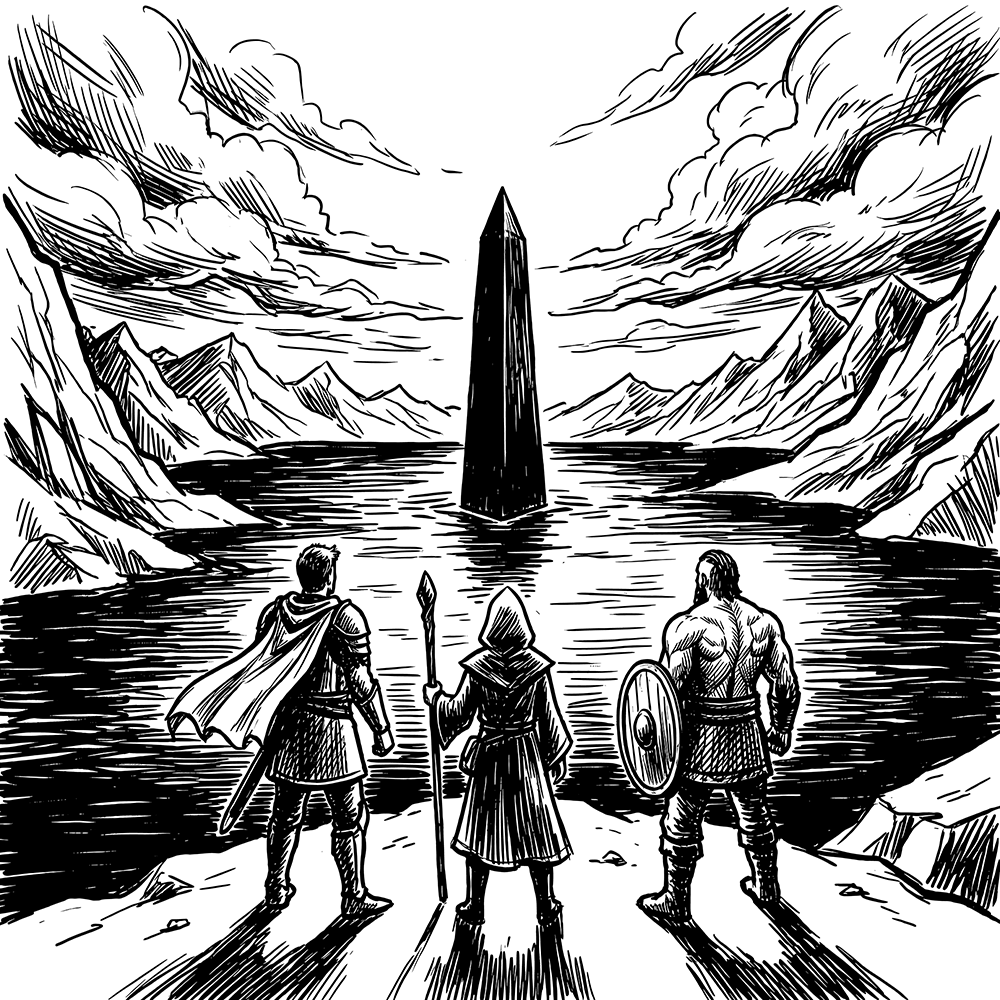
The Scene: In the center of a perfectly circular lake, whose waters are so dark and still that they seem to be made of liquid onyx, stands a black stone obelisk. The structure is about ten meters high and its surface is completely smooth, without any visible inscriptions or markings. There are no bridges or boats nearby, and the air around the lake is noticeably colder than the surrounding area. The water is strangely dense; stones thrown into it sink without making ripples.
The Details: Closer inspection (requiring the characters to swim or find a way to reach the obelisk) reveals that the stone is not simply dark; it appears to absorb light. Light touches on the surface produce a muffled sound and do not echo. During the full moon, however, ghostly silvery runes become visible on the obelisk’s north face, depicting a long-forgotten celestial language. Diving into the dark waters reveals that the obelisk extends far deeper than it rises, lost in the abyssal darkness.
The Mystery Explained: The obelisk is not a structure, but a nail. It was erected by an order of mages to trap and contain an entity of pure darkness, a “Sentient Void,” in the depths of the lake. The runes are part of the containment seal. The water is not water, but a dense, inert alchemical substance designed to suffocate and dampen the entity. If the obelisk is damaged or the runes are improperly disturbed, the seal will weaken. The “lake” will begin to drain rapidly, releasing the Void, which is not a physical creature, but an existential erasure force that will extinguish light, sound, and life in an ever-growing area. The reward? Knowledge. The runes, if deciphered correctly, contain arcane secrets about the nature of the void and light, potentially granting powers over darkness, but at the risk of unleashing annihilation.
II. The Bridge That Leads to a Solid Abyss
The Scene: A majestic arched bridge, made of perfectly preserved white marble, spans a deep gorge. The bridge is wide enough for a cart, and its balustrades are carved with intricate images of celestial creatures. The absurdity is evident: where the bridge should land on the other side of the gorge, it simply ends in mid-air, about 15 meters before reaching the other bank. There are no ruins on the opposite side, only a steep, untouched cliff.
The Details: The bridge is structurally sound and inexplicable. The sculptures tell the story of a builder god who joined the mountains as a gift for his mortal beloved. If one walks to the end of the bridge and looks down, the ravine will appear infinitely deep, with purple mists swirling in the depths. However, if a coin is tossed from the end of the bridge, instead of falling, it may flicker and reappear at the beginning of the bridge, or simply disappear. Detection spells reveal powerful transmutation and conjuration magic emanating from the end point.
The Mystery Explained: The bridge isn’t unfinished; it’s “undocked.” It was created as a permanent portal to a floating city or a paradisiacal plane. A catastrophe magically dislodged the bridge’s destiny, leaving it anchored only on one side. The “end” of the bridge is, in fact, an unstable dimensional rift. Crossing it doesn’t result in a fall, but in random transportation. With each crossing, the characters may end up in a different location: atop a distant mountain, in the ruins of the target city, or even in an elemental plane for a brief period before being ejected back to the bridge’s beginning. The mystery to be solved is how to realign the bridge with its original destiny, which may require finding the builder god’s “Map of Destinies” or performing a ritual at the opposite anchoring point.
III. The Amphitheater of Whispering Stones
The Scene: In a high, remote valley, a natural amphitheater has been enlarged by ancient hands. Concentric circles of stone benches carved from the bedrock descend toward a flat, circular stage. At the center of the stage, a single black basalt stele stands, marked with a single eye carved at the top. The place is eerily silent; even the wind seems to avoid the valley.
The Details: If a person sits on one of the benches, they will begin to hear faint whispers, as if a crowd were conversing around them. The whispers are in numerous languages, most of them unknown. If someone stands up and speaks on the stage, in front of the stele, the whispers will cease. The speaker will find that their words are repeated back to them, but in a language they have never heard, yet somehow understand perfectly. The stele does not move, but the carved eye seems to follow the movements of whoever is on the stage.
The Mystery Explained: The amphitheater is a “Forum of Spirits,” a place where the dead from all nations and eras can, briefly, be heard. The pews are not for the living, but for the specters of an eternal audience. The stele is an artifact that acts as a universal translator and mediator. Speaking on the stage allows the speaker to be heard by the dead and receive an answer, but the answer comes in the native tongue of a random spirit in the audience. The place can be used to obtain lost knowledge, but it is a dangerous game of roulette. A character might inquire about the location of a treasure and receive an accurate answer from an honest spirit, or might inadvertently attract the attention of a wicked liar or a possessive spirit who will try to follow the speaker back to the world of the living. The “eye” of the stele is the key: breaking it would silence the place forever, but would also trap all the spirits present inside, transforming them into furious ghosts.
IV. The Stone Spiral That Never Touches the Ground
The Scene: Atop a windy plateau, an impossible structure rises: an ascending spiral made of jagged rocks, about eight meters in diameter. The spiral rises at a gentle angle, making three complete turns before ending abruptly in mid-air, about ten meters above the ground. The strangest thing is that the stones are not supported by any visible pillar or support; the entire spiral floats, anchored only at its base. The stones are held together by an invisible force.
The Details: The spiral is physically solid and can be climbed. However, as one ascends, the effects of gravity diminish. At the top, a person can jump and float gently to the ground. The stones are common, but each has a small rune engraved on its underside, invisible from the ground. The runes, when read sequentially from the beginning to the end of the spiral, form a mathematical equation or a complex alchemical formula.
The Mystery Explained: The spiral is an unfinished magical experiment—the project of a mad archmage to create a “Gravitational Conductor.” His goal was to channel and redirect the region’s gravity to power a flying city. The archmage disappeared before completing the final activation ritual. The spiral is structurally stable, but dormant. The mystery is twofold: first, deciphering the formula (the runes) to understand its purpose; second, deciding what to do with it. Completing the ritual (requiring rare components and great risk) could stabilize the spiral and grant limited control over local gravity, or it could cause a disaster, unleashing an uncontrollable antigravitational field that would lift the entire plateau into the air before catastrophically collapsing.
V. The Icy Rainbow Portal
The Scene: Deep within a dark, perpetually shadowed valley, a massive stone arch rises. It is carved to resemble a frozen rainbow, its colorful bands represented by fine veins of rare minerals: green malachite, blue lapis lazuli, orange carnelian. The space within the arch is filled with an opalescent, static mist that does not dissipate. The surrounding air is cold enough that breath condenses, even on a summer’s day.
The Details: The portal leads nowhere; anyone who passes through it will simply emerge on the other side. However, during the few hours of the winter solstice, when sunlight strikes the arch at a specific angle, the mineral colors glow intensely and the mist within the arch clears, revealing a landscape of an eternally wintry forest under a purple sky. Passage is only possible during this window. Behind the arch, hidden by undergrowth, is a small bronze plaque with a warning in an ancient language: “Here lies the Summer of Yggr. May his sleep never end.”
The Mystery Explained: The portal is a prison. It doesn’t connect to another place in this world, but to a dimensional pouch containing the “Heart of Yggr’s Winter,” an elemental entity of perpetual winter that was defeated and sealed away long ago. The landscape seen through the portal is the entity’s prison itself. If the portal is crossed during the solstice, intruders will enter this pouch. Inside, summer does not exist, and the sleeping entity can be awakened. Destroying the “Heart” (a giant crystal in the center of the forest) would break the seal, releasing Yggr’s Winter into the main world, possibly initiating a new ice age. The portal is, therefore, a tempting trap offering the treasures of a primordial dimension, but with an apocalyptic risk.
VI. The Statue of the Afflicted Giant
The Scene: In the middle of an open plain, a colossal statue of a giant, about 30 meters tall, is kneeling. His hands are bound behind his back by stone chains, and his head is bowed downward, with an expression of eternal agony and surprise carved into his face. The statue is made of a granite that is not native to the region. Mosses and vines cover his legs, but his torso and face are strangely clean.
The Details: The statue is cold to the touch, even in sunlight. If someone were to climb the giant (a difficult task) and place an ear against its mouth or eye, they could hear a low, constant buzzing, as if a beehive were trapped inside the stone. Detection magic reveals a powerful aura of transmutation and enchantment, not in the statue as a whole, but emanating from within it.
The Mystery Explained: The statue is not a sculpture. It is a real giant, petrified at the moment of his final defeat. The chains are magical, part of the spell that turned him to stone. The buzzing is the sound of his consciousness, still trapped and active, going mad after centuries of imprisonment. The giant, named Korgun, was a warrior of a long-lost species. He was not inherently evil, but was turned to stone by a powerful sorcerer-king who feared his power. The mystery is how to free him. Breaking the statue would likely kill him. The key to reversing the spell may lie in the hands of the sorcerer (now a lich or a ghost) or in a “kiss of a phoenix” (a rare item). If freed, Korgun could be a powerful ally, but also an unpredictable force of chaos, filled with resentment for his long captivity.
VII. The Circle of Menhirs with Inverted Shadows
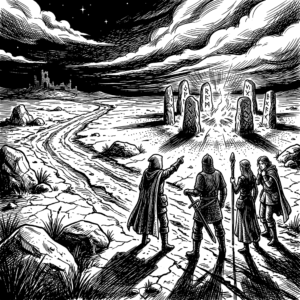
The Scene: A circle of twelve grey granite monoliths rises on a grassy hill. The stones are of varying heights and bear no markings. The obvious mystery manifests itself at midday, under direct sunlight: while all other objects on the hill cast normal shadows, the menhirs cast shadows that point toward the sun, as if the light source were below them.
The Details: Inside the circle, the temperature is always a few degrees cooler. Sounds are muffled. If a person stands in the exact center of the circle at noon, their own shadow will also invert, pointing towards the sky. At that moment, they can hear a silent “crack” and then hear the sounds of the outside world, but these sounds come from a day in the future. They can hear themselves and their companions discussing something that hasn’t happened yet.
The Mystery Explained: The circle is not a ritual site, but a “Temporal Twist Point.” The stones are natural, but were accidentally erected in a location where the fabric of time is thin. They act as an antenna, focusing on this anomaly. The inverted shadows are a visual side effect of this twist. The circle does not allow physical time travel, but it does allow brief, random eavesdropping on near-future timelines. The information obtained can be crucial (warning of an ambush) or disorienting (overhearing a trivial conversation). The danger is that repetitive use can attract the attention of “Timeline Polishers”—extraplanar entities that “repair” tears in time and may see the characters as an infestation to be eradicated. The circle is a powerful information tool, but with a potentially catastrophic cost.
VIII. The Lower City of Rooftops
The Scene: On a vast plain of cracked earth, the characters find what appears to be the foundations of a city, but there are no walls or tall buildings. Instead, what they see are hundreds of roofs of different styles and materials—clay tiles, thatch, slate, even green copper roofs—all at ground level, as if the entire city had been pressed down into the earth. Doors and windows are visible, but they lead underground.
The Details: The roofs are structurally sound. The “doors” lead to staircases that descend to what would be the upper floors of the buildings, now completely underground. The interior is preserved, but everything is upside down or sideways, depending on the building’s orientation. Furniture is attached to what should be the ceiling. It is disorienting and dangerous to navigate.
The Mystery Explained: The city, once a thriving metropolis, fell victim to a powerful “Earth Reversal” spell, cast by a wizard betrayed by his ruler. The spell didn’t destroy the city, but pulled it underground, reversing its relationship with the surface. Most of the inhabitants perished, but some adapted, living in the inverted spaces. The subterranean city is now inhabited by creatures that thrive in the dark: troglodytes, giant rats, and perhaps even the ghosts of the original citizens, trapped in their inverted existence. The mystery is how to reverse the spell or, at least, safely plunder the city. The treasure is still there; the vaults and nobles’ chambers remain intact, but are now dangerous ceilings or walls. Residual magic from the spell can still cause strange gravity distortions within the structures.
IX. The Forge beneath the Frozen Falls
The Scene: A colossal waterfall, hundreds of feet high, has been completely frozen in time. The solid, crystalline water captures the movement of the fall, with droplets and foam suspended in the air. Behind the curtain of ice, hidden in the cliff face, lies the entrance to a cave. Inside, the light from a forge still glows, casting orange and red hues through the ice.
The Details: The ice is thick and cold; it is impossible to melt it by normal means. The entrance can only be reached by finding a secret passage through the caves behind the waterfall or by magically breaking the ice. Inside, the cave is warm and stuffy. The forge is still lit, kept alight by a weak elemental fire, and a blacksmith’s tools are arranged as if he had just left for lunch. A single item is being forged on the anvil: a perfect, gleaming blade, caught in the final moments of its temper.
The Mystery Explained: The blacksmith was a master dwarf named Dorin, who discovered how to forge with the “Fire from the Bottom of the World.” He was creating a weapon to slay an ice dragon god. The dragon, sensing the threat, cast a time-paralysis spell on the waterfall and the cave before Dorin could complete the weapon. Dorin is trapped in a time loop outside the cave, eternally repeating his futile struggle against the dragon, invisible to the outside world. The blade on the anvil is complete, but its ultimate power will only be unleashed when the tempering is finished. The characters can attempt to free Dorin by breaking the spell (finding and killing the sleeping dragon in the nearby mountains) or they can attempt to complete the blade’s tempering themselves, a complex and dangerous process that could grant them a legendary weapon or destroy the forge and themselves in the process.
X. The Lighthouse that Illuminates the Earth
The Scene: On a rocky promontory by the sea, a tall, elegant lighthouse stands. Its lantern, however, does not project a rotating beam of light over the sea. Instead, it emits a cone of pure, steady white light that shines downwards , intensely illuminating the base of the promontory and the waves crashing against it. The lighthouse is deserted and in a state of disrepair, but the light continues to shine uninterruptedly, day and night.
The Details: Inside the lighthouse, the spiral staircase is covered in dust, but the lantern room is immaculate. The light source is a large, gleaming crystal stone suspended in the center of the room, with no optical mechanism surrounding it. The light emanating from it is cold and casts no shadow when anything is placed in its path. Looking directly at the crystal is blinding. Detection spells reveal a powerful abjuration spell, not an evocation spell.
The Mystery Explained: The lighthouse wasn’t built to warn ships, but to contain something. The light isn’t for illumination, but for suppression. In the cave beneath the promontory, accessible only by an underwater tunnel, a rift to the Abyssal Depths has been sealed. The corrupting creature or influence emanating from the rift is kept in check by the purifying light of the crystal. The lighthouse was maintained by a long-extinct religious order. If the light is extinguished (damaging the crystal or covering it), the suppression will cease, and the corruption from the Depths will begin to leak out, corrupting marine life, driving local fishermen mad, and eventually allowing lesser abyssal entities to manifest. The mystery for adventurers is to discover the lighthouse’s true purpose and decide whether to keep it (potentially requiring a quest to find a new guardian or rekindle a failed crystal) or risk exploring the now-suppressed cave in search of the treasures the imprisoned entities may have left behind.